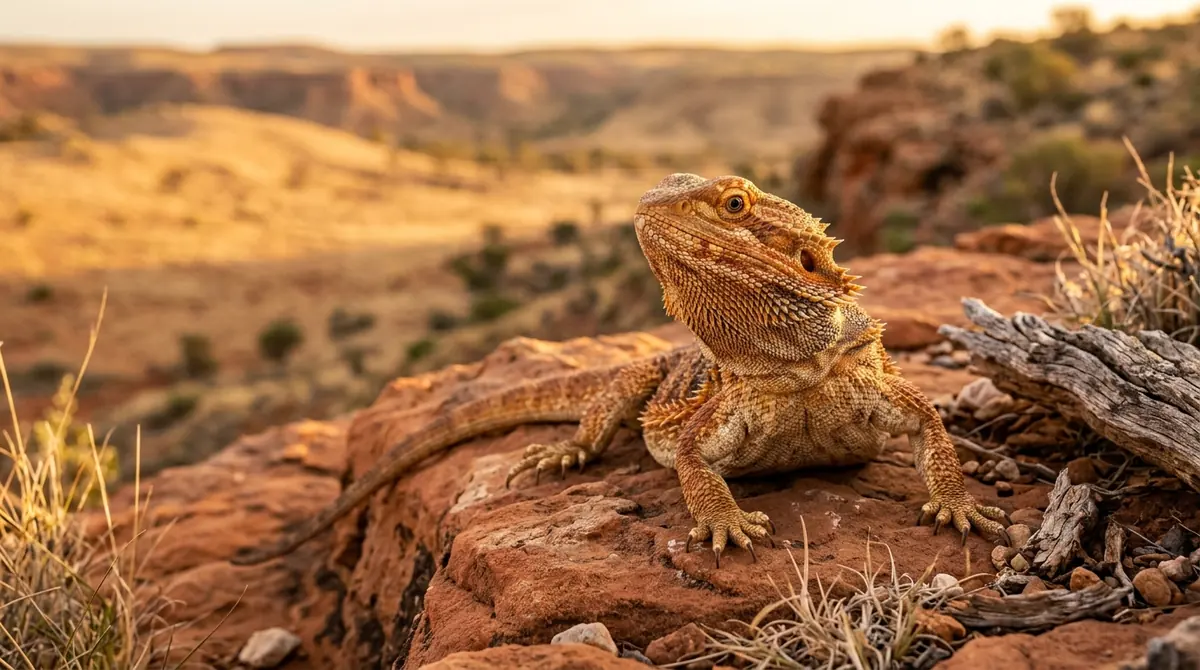
Choosing the right bearded dragon tank size and setup is one of the most important steps in creating a suitable home for your reptile. An enclosure that is too small can restrict movement, while poor heating, lighting, or habitat design can make it difficult for a bearded dragon to regulate its body temperature and behave naturally.
For most adult bearded dragons, a 4 × 2 × 2-foot enclosure (120 gallons) is a widely used minimum, while newer welfare-focused recommendations favor 6 × 2 × 2 feet (180 gallons) or larger.
But choosing the tank is only the beginning. A suitable habitat must also include a warm basking area, a cooler retreat, proper UVB lighting, safe substrate, hiding spaces, and climbing opportunities.
This guide explains how to select an enclosure for a baby, juvenile, or adult bearded dragon and set it up step by step.
Table of Contents
What Size Tank Does a Bearded Dragon Need?
The appropriate tank size depends on the animal's physical size, growth, and need for space to move, climb, and regulate its body temperature.
Bearded dragons are active, primarily ground-dwelling lizards that also use elevated surfaces. A suitable enclosure should provide both horizontal space and usable height.
| Life stage | Enclosure guidance | Important considerations |
|---|---|---|
| Baby | A properly arranged 4 × 2 × 2 ft enclosure can be used from the beginning | Easy access to food, hides, heat and UVB |
| Juvenile | Plan for a full adult-sized enclosure | Rapid growth makes small tanks a short-term option |
| Adult | 4 × 2 × 2 ft is a commonly cited minimum | More room for movement and environmental choices is better |
| Adult — preferred larger setup | 6 × 2 × 2 ft or larger | Current ReptiFiles guidance for most adults |
These are planning guidelines rather than age-based legal requirements. A dragon's actual size and enclosure conditions matter more than a rigid age category.
The RSPCA gives an adult enclosure range of approximately 4–6 feet long. Reptiles and Research identifies 4 × 2 × 2 feet as its minimum and describes larger setups as preferable. ReptiFiles currently recommends at least 6 × 2 × 2 feet for most adult central bearded dragons, with an exception for unusually small adults.
Practical recommendation: If you're buying a permanent enclosure for a new bearded dragon and have the space and budget, prioritize a well-designed 6-foot enclosure. A 4 × 2 × 2-foot setup remains an established minimum in other husbandry guidance, but it should not be treated as the maximum space a dragon needs.
Is a 40-Gallon Tank Big Enough for a Bearded Dragon?
A 40-gallon enclosure may be used temporarily for a small juvenile, depending on the animal's size and how well the habitat is arranged.
However, it is not a suitable permanent enclosure for a typical adult bearded dragon.
A small enclosure offers less room for climbing, exploration, hiding, and maintaining a temperature gradient.
Buying a 40-gallon tank and upgrading several times can also increase the total cost of ownership.
For many beginners, choosing a permanent adult-sized enclosure from the start is more practical.
Is a 75-Gallon Tank Big Enough?
A 75-gallon tank is larger than many traditional starter aquariums, but its dimensions may still be inadequate for an adult bearded dragon.
Tank volume alone does not tell you how much usable space an animal has.
For example, a long but narrow aquarium can restrict turning, climbing, and arranging basking equipment.
Check the enclosure's actual length, width, and height before purchasing it.
Is a 120-Gallon Tank Big Enough?
A 120-gallon enclosure measuring 48 × 24 × 24 inches meets the commonly cited 4 × 2 × 2-foot standard.
It can accommodate a suitable basking area, cooler retreat, hides, and basic enrichment when arranged properly.
However, it is important to distinguish between a widely accepted minimum and a more spacious welfare-focused enclosure.
ReptiFiles now recommends larger accommodation for most adults. Where possible, owners should consider additional floor space and usable height.
Is a 180-Gallon Tank Better?
A typical 180-gallon enclosure measuring 72 × 24 × 24 inches provides two additional feet of length compared with a 4 × 2 × 2-foot setup.
This can offer:
- More room for exploration and movement.
- Greater flexibility when arranging climbing branches and platforms.
- More separation between warm and cool zones.
- Additional hiding and enrichment opportunities.
A larger enclosure still requires correctly positioned UVB lighting, heating equipment, and temperature monitoring. Space alone does not guarantee a suitable habitat.
Bearded Dragon Tank Dimensions: Why Size Matters More Than Gallons
Reptile enclosures are commonly marketed by their gallon capacity, but dimensions are usually more useful when evaluating bearded dragon housing.
| Enclosure | Dimensions | Approximate volume |
|---|---|---|
| Standard adult enclosure | 48 × 24 × 24 inches | 120 gallons |
| Larger adult enclosure | 72 × 24 × 24 inches | 180 gallons |
These are nominal enclosure volumes calculated from external dimensions. Actual usable internal space may differ.
The longer enclosure provides more horizontal space, which is particularly valuable because bearded dragons spend considerable time walking and exploring.
Height also matters. Dragons climb branches, bask on elevated surfaces, and benefit from opportunities to move vertically.
However, usable height must be balanced with safe distances from UVB and heating fixtures.
Key takeaway: Prioritize usable dimensions, suitable environmental gradients, and enrichment over a gallon number on a product listing.
Best Types of Bearded Dragon Enclosures
Bearded dragon enclosures are made from several materials, each with advantages and limitations.
PVC Reptile Enclosures
PVC enclosures are a common option for larger, permanent reptile habitats.
Advantages:
- Often available in 4-foot and 6-foot configurations.
- Opaque sides can help provide visual security.
- Many models have front-opening doors.
- Relatively easy-to-clean surfaces when properly constructed.
Considerations:
- Ventilation varies between models.
- Heat retention differs from glass enclosures.
- Lamp-mounting arrangements require attention to manufacturer instructions.
A PVC enclosure can be a practical choice for a permanent bearded dragon setup when its construction, ventilation, and equipment mounting are appropriate.
Glass Terrariums
Glass terrariums offer clear visibility and are widely sold in pet stores.
Advantages:
- Good visibility for observing the animal.
- Easy-to-wipe surfaces.
- Some models have convenient front-opening doors.
Considerations:
- Large models can be heavy.
- Glass may lose heat differently from PVC.
- Reflections may contribute to stress in some individuals.
- Available dimensions may be limited.
A glass enclosure can work if it provides adequate space, ventilation, and appropriate environmental conditions.
Wooden or Melamine Enclosures
Sealed wooden enclosures can provide sturdy housing and are often used in custom reptile setups.
Their suitability depends on moisture-resistant finishing, cleaning accessibility, heat-safe construction, and ventilation.
Unsealed or damaged surfaces can absorb waste and moisture, making sanitation more difficult.
Front-Opening vs. Top-Opening Tanks
Front-opening doors can make feeding, cleaning, and routine interaction more convenient.
They also allow access without reaching directly down from above.
Top-opening enclosures are not automatically unsuitable, but access can be less convenient, especially in large, heavily furnished setups.
For a permanent bearded dragon habitat, front-opening access is generally a useful feature.
Bearded Dragon Tank Setup: Step-by-Step Instructions
Once the enclosure has been selected, the next task is arranging the habitat so the reptile can access suitable heat, light, shelter, and enrichment.
The following sequence is useful for beginners.
Step 1: Choose a Safe Location
Place the enclosure on a sturdy, level surface that can safely support the complete setup.
Choose an area away from:
- Direct drafts.
- Air-conditioning vents.
- Radiators or other uncontrolled heat sources.
- Areas exposed to strong temperature fluctuations.
- Excessive household traffic.
- Kitchen and food preparation areas.
Avoid relying on sunlight through a window for UVB. Ordinary window glass blocks much of the UVB needed by reptiles, and direct sun can also overheat a glass enclosure.
Ensure electrical connections remain dry and protected.
Step 2: Install the Substrate
Substrate covers the enclosure floor and influences hygiene, traction, and natural behavior.
Common options include paper-based temporary flooring, appropriately textured solid surfaces, and carefully selected naturalistic loose substrates.
Paper towels
These are easy to replace and useful during quarantine, temporary housing, or periods when droppings need close monitoring.
They do not provide digging opportunities, so they are generally more useful as a temporary management option than as enrichment.
Textured tile or slate
Appropriate textured surfaces can be easy to spot-clean and provide stable footing.
However, an entirely hard-surfaced enclosure may limit digging behavior, and a lack of softer or varied surfaces may be undesirable.
Naturalistic loose substrate
Suitable loose substrates can support digging and other natural behaviors.
However, their use requires appropriate material selection, hygiene, and overall husbandry.
Loose substrate is not automatically unsafe, but neither is every sand-based commercial product suitable.
Avoid sharp gravel, unsuitable wood chips, and substrates that may create ingestion or sanitation problems.
For a beginner, it is reasonable to use a simple, easy-to-clean temporary substrate while learning to maintain the habitat and environmental conditions.
Step 3: Create a Warm and Cool Side
Bearded dragons are ectothermic and depend on external heat to regulate their body temperature.
A suitable enclosure therefore needs a temperature gradient.
Place the main basking heat source toward one end of the enclosure rather than heating the entire habitat uniformly.
The opposite end should provide access to a cooler retreat.
This allows the bearded dragon to move between different temperatures as needed.
| Warm end | Center | Cool end |
|---|---|---|
| Basking platform | Open space and climbing structures | Cooler hide |
| Heat lamp overhead | Appropriate UVB access | Shaded area |
| Surface-temperature measurement | Transitional temperatures | Cool-side air thermometer |
Temperature measurements need to distinguish basking surface temperatures from surrounding air temperatures.
Do not assume that a thermostat reading at one point represents the entire enclosure.
Step 4: Install a Suitable Basking Heat Lamp
A basking heat lamp provides warmth at a defined basking location.
Position it over a stable, appropriately sized platform or rock.
The basking area should allow the reptile to warm its body without touching the lamp or an unsafe fixture.
The correct lamp output depends on:
- Enclosure dimensions.
- Room temperature.
- Fixture and reflector design.
- Distance from the basking platform.
- Ventilation.
- Heat retention of enclosure materials.
Avoid selecting bulb wattage solely from a generic online recommendation.
Measure the resulting temperatures and adjust the setup using suitable controls.
Step 5: Install UVB Lighting
Bearded dragons require appropriate UVB exposure for vitamin D3 production and calcium metabolism.
For many larger enclosures, a suitable high-output linear UVB fixture is preferred over small compact lamps because it can provide a more useful exposure area.
However, UVB output depends on lamp type, reflector, mounting distance, mesh obstruction, and the position of the animal.
A lamp that is suitable in one enclosure may provide inadequate or excessive exposure in another.
Place the UVB system so that the dragon can access appropriate radiation when basking while retaining shaded areas.
Follow manufacturer guidance for installation and use measurement equipment where possible.
Avoid putting ordinary glass or plastic between the UVB lamp and the animal.
A complete lighting arrangement should also provide a predictable day-night cycle.
Step 6: Add Hiding Places
Hides allow a bearded dragon to retreat from activity, light, and perceived threats.
Provide appropriately sized hides at different points in the enclosure.
A practical arrangement includes:
- A hide toward the warm end.
- A hide toward the cooler end.
- Additional shaded retreats when space allows.
Hides should be stable, accessible, and large enough for the animal to enter and turn around comfortably.
Avoid decorations with sharp edges or narrow openings that may trap the reptile.
Step 7: Add Branches, Rocks, and Climbing Structures
Bearded dragons are capable climbers, and a completely empty enclosure does not offer enough behavioral variety.
Suitable furnishings may include:
- Secure branches.
- Stable rocks.
- Elevated basking platforms.
- Low climbing structures.
- Different surface textures.
- Safe, accessible shaded areas.
Heavy rocks should be supported securely rather than balanced on loose substrate.
Check that structures cannot roll, collapse, or trap the animal.
The goal is to create a functional environment that supports exploration and normal movement, not simply an attractive display.
Step 8: Add Food and Water Dishes
Use sturdy, accessible dishes that are easy to clean.
A shallow water dish should be available and refreshed regularly.
Food dishes should be positioned where they will not be easily contaminated by waste or loose substrate.
Avoid placing water directly beneath intense heat if it creates unnecessary evaporation or humidity problems.
Step 9: Install Temperature and Humidity Monitors
A functional enclosure should have instruments that allow you to verify environmental conditions.
Useful equipment includes:
- Digital thermometers with appropriate probes.
- An infrared temperature gun for suitable surface measurements.
- A digital hygrometer.
- Suitable heating controls.
- A timer for the lighting schedule.
Place sensors at relevant locations rather than relying entirely on a single reading.
Record measurements after the habitat has been operating long enough to reach stable conditions.
Step 10: Test the Setup Before Introducing Your Dragon
Run the complete enclosure before bringing the reptile home.
Test heating and lighting through a normal daytime cycle and check overnight temperatures.
Confirm that:
- The basking area reaches an appropriate temperature.
- The cool side remains accessible and suitably cooler.
- UVB fixtures are correctly installed.
- Heating equipment cannot be touched accidentally.
- Hides and climbing platforms are secure.
- Humidity is appropriate.
- Doors and ventilation openings are safe.
- There are no loose electrical connections.
Do not introduce the animal until major environmental problems have been corrected.
Bearded Dragon Tank Temperature and Humidity
Temperature and humidity require regular monitoring because enclosure size, room conditions, and equipment can change the results.
| Enclosure zone | What to measure |
|---|---|
| Basking surface | Surface temperature where the dragon sits |
| Warm-side air | Ambient air near the warm end |
| Cool-side air | Ambient air in the cooler retreat |
| Nighttime environment | Temperature after daytime heating switches off |
Published basking recommendations differ, often because sources describe different measurements.
The RSPCA describes a broader enclosure gradient, and university veterinary references may give different basking targets.
For that reason, it is important to verify the specific temperature guidance you follow and measure the correct location rather than copying a number without context.
A reptile veterinarian or experienced husbandry specialist can help resolve conflicting recommendations for a particular enclosure.
Humidity Requirements
Bearded dragons generally require a relatively dry, well-ventilated habitat.
The RSPCA care sheet recommends an enclosure humidity range around 30–40%, although readings can vary across the enclosure and throughout the day.
Humidity should be checked with a digital hygrometer.
Persistent dampness, inadequate ventilation, or wet substrate may create problems.
Do not mist the entire enclosure routinely without a specific husbandry reason.
Bearded Dragon Tank Layout: A Practical Example
A well-planned enclosure does not need to be packed with decorations.
Instead, it should provide meaningful environmental choices.
Warm side:
- Stable elevated basking platform.
- Heat lamp.
- Appropriate UVB exposure.
- Access to a nearby hide.
Middle:
- Secure branches or climbing structures.
- Open movement space.
- Varied surfaces.
Cool side:
- Shaded hiding area.
- Cooler resting locations.
- Accessible water dish, positioned appropriately.
The exact layout should be adapted to the enclosure's dimensions and actual temperature measurements.
An uncluttered but functional environment is better than decorative furnishings that interfere with movement or heating.
Essential Bearded Dragon Tank Setup Checklist
Use this checklist before purchasing or introducing a bearded dragon.
| Item | Purpose | Essential? |
|---|---|---|
| Appropriately sized enclosure | Space and environmental choice | Yes |
| Secure doors and ventilation | Safety and air exchange | Yes |
| Basking heat lamp | Warm basking location | Yes |
| Suitable UVB system | Supports calcium metabolism | Yes |
| Appropriate heat controls | Safer equipment management | Yes |
| Digital thermometers | Ambient temperature monitoring | Yes |
| Infrared temperature gun | Basking-surface readings | Strongly recommended |
| Digital hygrometer | Humidity monitoring | Yes |
| Stable basking platform | Accessible warm surface | Yes |
| Warm and cool hides | Secure resting places | Yes |
| Suitable substrate | Hygiene and footing | Yes |
| Secure branches and enrichment | Natural behaviors | Yes |
| Water dish | Drinking water | Yes |
| Food dish | Clean feeding | As appropriate |
| Lighting timer | Consistent lighting schedule | Strongly recommended |
When comparing commercial enclosure kits, check their actual included equipment. A starter kit may omit important items or contain accessories that are not suitable for a permanent adult habitat.
Common Bearded Dragon Tank Setup Mistakes
Buying Based Only on Gallon Capacity
An enclosure may have a large advertised volume but insufficient floor space.
Compare physical dimensions first.
Using a Small Starter Tank for Too Long
A small tank can become unsuitable as a dragon grows.
Plan the adult habitat early to avoid repeated expensive upgrades.
Placing Heat and Lighting Incorrectly
Incorrect mounting distances can create unsafe temperatures or inadequate UVB exposure.
Follow the equipment manufacturer's specifications and verify actual environmental readings.
Creating No Temperature Gradient
An enclosure that is uniformly warm prevents normal behavioral thermoregulation.
Provide distinct warm and cool zones.
Using Unstable Decorations
Loose rocks and unsecured branches can cause injuries.
Make sure every heavy or elevated structure is stable.
Ignoring Ventilation
Poor ventilation can contribute to moisture buildup and unhealthy enclosure conditions.
Choose equipment and enclosure designs that support appropriate airflow.
Housing Multiple Dragons Together
Bearded dragons are generally solitary animals.
Shared housing can cause competition, chronic stress, and injuries.
For beginners, one bearded dragon per enclosure is the safer recommendation.
Cleaning Tank Equipment in the Kitchen
Reptiles may carry Salmonella, even when they appear healthy.
Clean reptile supplies outside when possible and never in food preparation areas.
The CDC recommends thorough handwashing after handling reptile habitats or equipment.
How Often Should You Clean a Bearded Dragon Tank?
Regular cleaning supports both animal welfare and household hygiene.
Daily Cleaning
- Remove feces and visibly contaminated substrate.
- Discard old fresh food.
- Replace drinking water.
- Clean soiled dishes.
- Check for damaged or unsafe furnishings.
Weekly Inspection
- Examine enclosure surfaces and accessories.
- Inspect the heating and lighting equipment.
- Review temperature and humidity readings.
- Clean and disinfect items as needed.
- Check substrate condition.
Periodic Deep Cleaning
Follow an appropriate cleaning and disinfection schedule based on enclosure type and substrate.
Use reptile-compatible products according to their label instructions, including required dilution, contact time, rinsing, and drying.
Keep cleaning supplies separate from household food equipment.
The CDC recommends cleaning reptile equipment outside the home whenever possible. If cleaning indoors is necessary, use a designated laundry sink or bathtub and thoroughly clean and disinfect it afterward.
Frequently Asked Questions
What is the best tank size for an adult bearded dragon?
A 4 × 2 × 2-foot enclosure is a widely cited minimum, but larger setups are preferable. ReptiFiles currently recommends at least 6 × 2 × 2 feet for most adult bearded dragons.
Can a baby bearded dragon live in a 120-gallon tank?
Yes, a baby can be housed in a properly arranged adult-sized enclosure if food, water, hides, lighting, and suitable temperatures are accessible and the animal can be monitored effectively.
Can a bearded dragon live in a 40-gallon tank?
A 40-gallon tank may be used temporarily for a small juvenile, but it should not be considered adequate permanent housing for a typical adult.
What is better for a bearded dragon: glass or PVC?
Both can work when properly constructed and equipped. PVC is common in large front-opening enclosures, while glass provides visibility. The best option depends on dimensions, ventilation, heat management, and cleaning accessibility.
Should a bearded dragon tank be long or tall?
Bearded dragons benefit from both floor area and climbing space. A relatively long enclosure is particularly important, but usable height should also be provided where possible.
Do bearded dragons need a hiding spot?
Yes. Secure hiding areas allow bearded dragons to retreat from light, activity, and perceived threats.
Can two bearded dragons share a 120-gallon tank?
Cohabitation is generally discouraged regardless of tank size. Bearded dragons can compete for space and resources, and serious injuries may occur.
What should be at the bottom of a bearded dragon tank?
Suitable options include temporary paper-based flooring, textured solid surfaces, or carefully selected naturalistic substrate. The best option depends on the animal's needs, enclosure management, and husbandry standards.
How do you know if a bearded dragon tank is set up correctly?
Use appropriate measuring equipment to verify basking surface temperature, air-temperature gradient, humidity, UVB placement, and equipment safety. The animal must also have access to hides, climbing structures, and appropriate feeding and watering areas.
Final Thoughts
The best bearded dragon tank setup is not necessarily the most expensive or visually elaborate one.
A suitable enclosure provides enough room for movement, safe opportunities for climbing, secure hiding places, appropriate UVB exposure, and a temperature gradient that allows the animal to regulate its body temperature.
For beginners, prioritize the enclosure's physical dimensions over its advertised gallon capacity.
A 4 × 2 × 2-foot enclosure remains a commonly cited adult minimum, while more spacious 6- foot habitats better align with newer recommendations for most adult bearded dragons.
Most importantly, install and test the full habitat before introducing the animal.
A carefully planned enclosure can make routine care easier while supporting a bearded dragon's health and natural behavior.
Research References
1. RSPCA Australia — How Should I Care for My Bearded Dragon? 2. ReptiFiles — Bearded Dragon Enclosure Size and Cohabitation 3. Reptiles and Research — Bearded Dragon Care Guide 4. UC Davis School of Veterinary Medicine — Bearded Dragon Care
5. VCA Animal Hospitals — Bearded Dragons: Housing 6. CDC — Reptiles and Amphibians: Healthy Pets, Healthy People
Editorial disclosure: This article is based on published husbandry and veterinary resources. It does not represent firsthand product testing or individualized veterinary advice. Owners should consult a reptile-experienced veterinarian when making decisions involving animal health or safety.