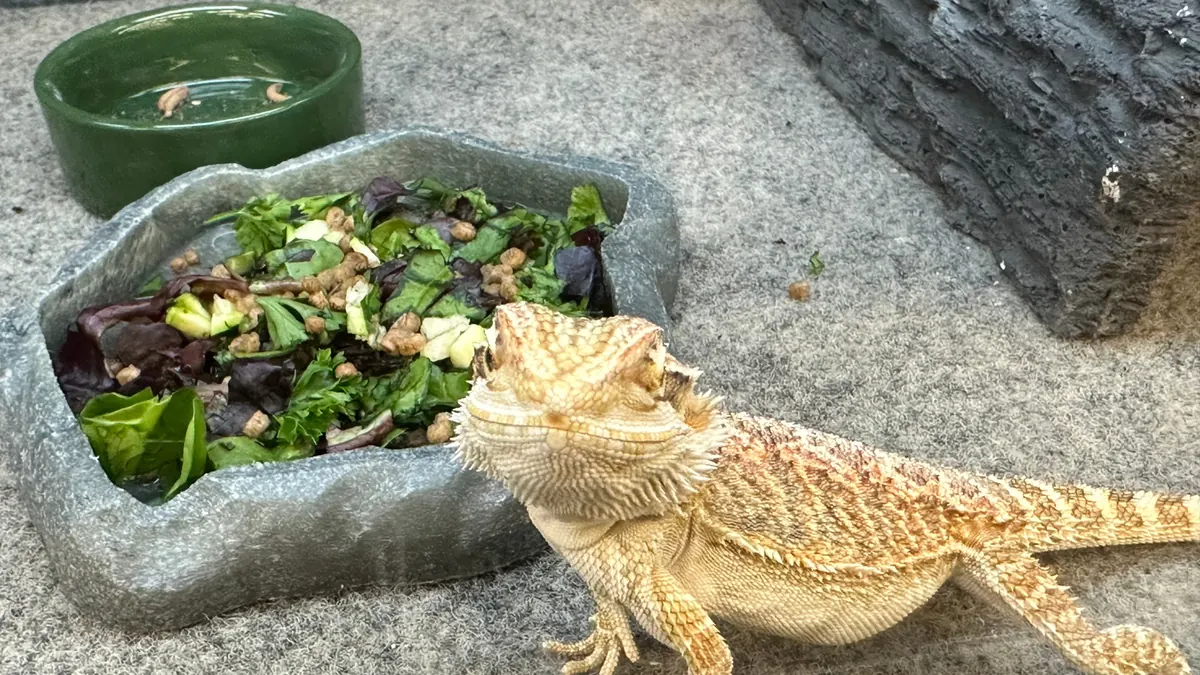
The best vegetables for bearded dragons are nutrient-rich leafy greens such as collard greens, mustard greens, turnip greens, dandelion greens and escarole. These make a strong foundation for a varied plant-based diet, especially for adult bearded dragons.
Butternut squash, bell peppers, green beans and zucchini can add variety. Bearded dragons are omnivores, so vegetables are just one part of their overall nutrition. Younger animals generally need more insect-based food than adults.
This guide explains which greens to offer regularly, which vegetables to limit, how to prepare salads and what to do if your bearded dragon refuses vegetables.
Table of Contents
What Vegetables Can Bearded Dragons Eat Every Day?
For most healthy adult bearded dragons, rotating appropriate dark leafy greens is a sensible approach to daily vegetable offerings. Collard greens, mustard greens, turnip greens, dandelion greens, escarole, endive and watercress are all useful options.
Rather than serving one ingredient indefinitely, combine or rotate several. Washington State University's Veterinary Teaching Hospital describes an adult diet with approximately 50–55% dark leafy greens, 20% other vegetables and 25% insects, with fruit no more than 5%. NC State Veterinary Hospital also emphasizes a predominantly plant-based adult diet. These figures describe broad dietary patterns, not precise instructions for each individual salad.
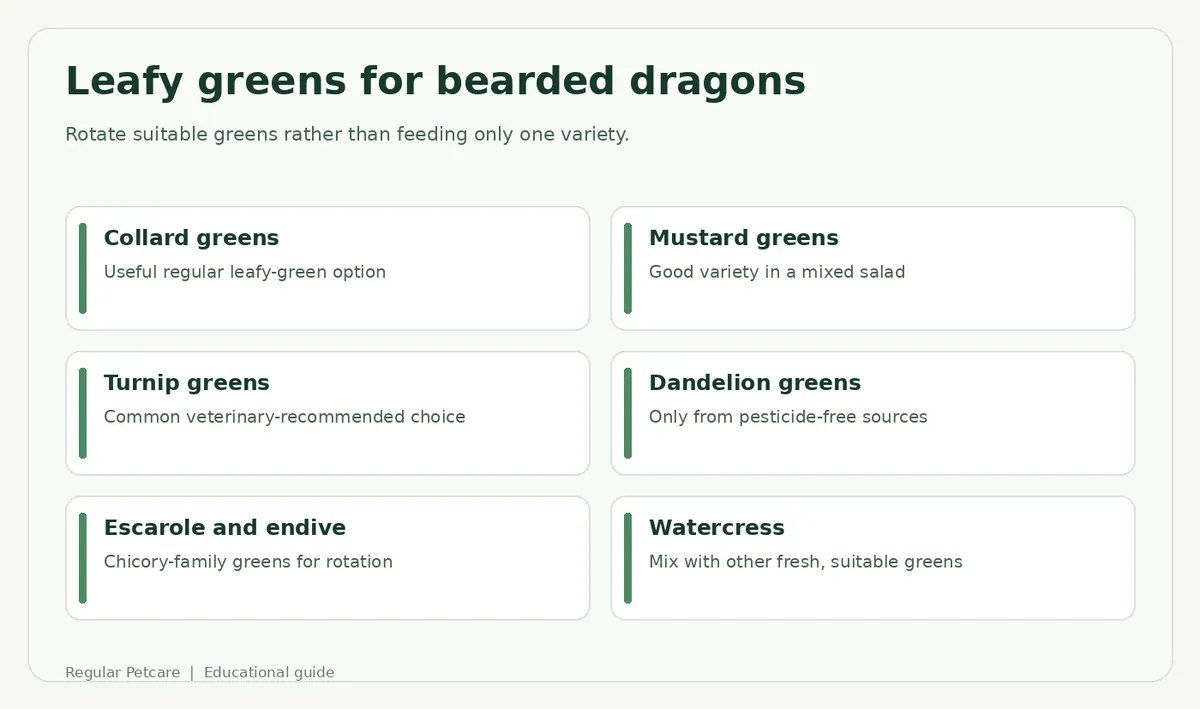
Best Vegetables and Greens Chart
| Vegetable or green | Suggested role | Preparation or concern |
|---|---|---|
| Collard greens | Regular leafy-green rotation | Nutrient-rich option |
| Mustard greens | Regular leafy-green rotation | Useful variety |
| Turnip greens | Regular leafy-green rotation | Commonly recommended |
| Dandelion greens | Regular leafy-green rotation | Choose pesticide-free sources |
| Escarole / endive | Regular leafy-green rotation | Add texture and variety |
| Watercress | Regular leafy-green rotation | Wash thoroughly |
| Butternut squash | Additional vegetable | Finely grate or chop |
| Bell peppers | Additional vegetable | Remove stem and seeds |
| Green beans | Additional vegetable | Serve fresh and chopped |
| Zucchini | Additional vegetable | Do not let it dominate meals |
| Carrots | Additional vegetable | Grate or chop finely |
| Cucumber | Limited addition | High water content |
| Romaine lettuce | Supplemental green | Less nutrient-dense than preferred greens |
| Spinach | Limit or avoid as a staple | Contains oxalates |
These categories are practical guidance, not a one-size-fits-all veterinary prescription. Adjust feeding according to age, health and your reptile veterinarian's advice.
7 Best Leafy Greens for Bearded Dragons
Leafy greens should make up most of the plant portion of an adult bearded dragon's diet. VCA Animal Hospitals suggests that roughly 80–90% of the vegetable portion should be leafy greens.
1. Collard Greens
Collards provide useful nutrients, including calcium, and have firm leaves that are easy to wash and chop. Remove especially tough stems when needed, then cut the leaves into manageable pieces. They pair well with mustard greens or escarole.
2. Mustard Greens
Mustard greens offer vitamins and minerals alongside a different flavor and texture. Rinse, remove damaged areas and chop into suitable pieces. Rotate with collard or turnip greens.
3. Turnip Greens
The leafy tops of turnips appear in veterinary feeding recommendations. Use fresh, clean leaves and cut them into bite-sized pieces. Combine with collards or pesticide-free dandelion greens.
4. Dandelion Greens
Dandelion leaves can be a useful food, but their source matters. Do not gather them from treated lawns, roadsides or other potentially contaminated areas. Select properly identified, pesticide-free leaves and wash them thoroughly.
5. Escarole
Escarole is a leafy member of the chicory family and adds variety to salads. Wash thoroughly and tear or chop into small, appropriate pieces. Rotate with collards, mustard greens and endive.
6. Endive
Endive, another chicory-family green, brings a different texture to mixed salads. Wash and chop it. It is best used as one component of a varied diet rather than as the sole green for long periods.
7. Watercress
Watercress can be mixed with other fresh greens. Use reliable food sources, wash thoroughly and avoid aquatic plants collected from uncertain or contaminated environments.
Best Non-Leafy Vegetables for Bearded Dragons
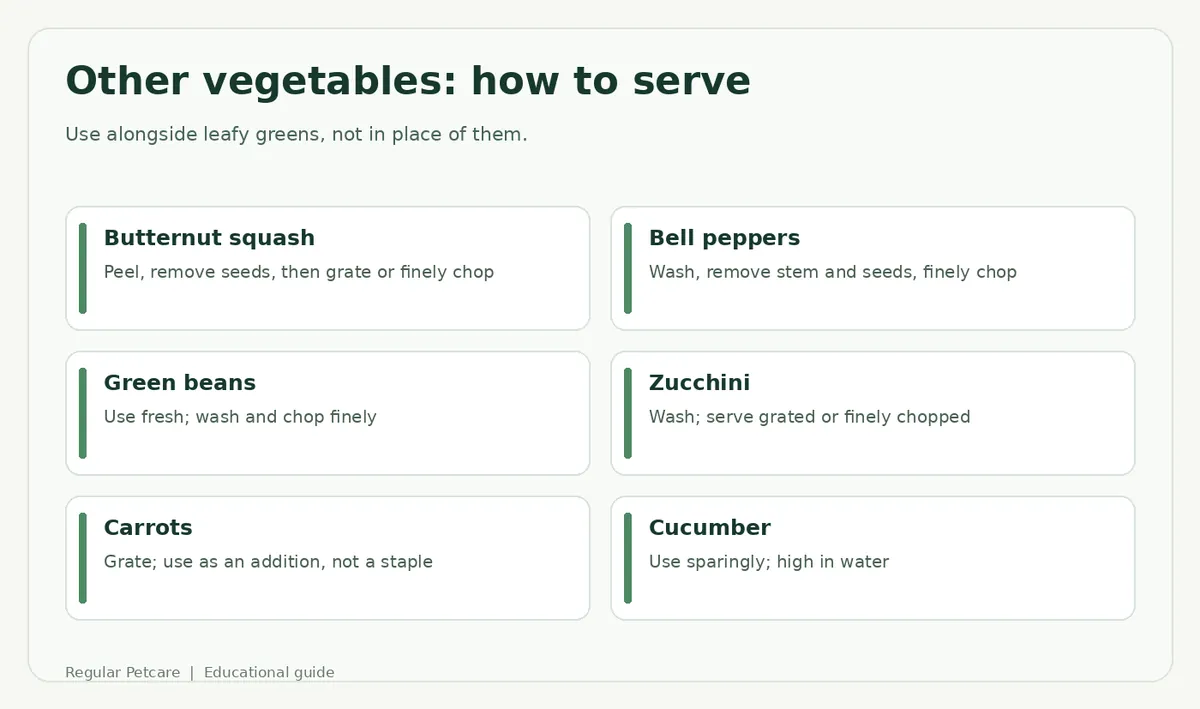
Other vegetables can provide variety in color, texture and nutrients alongside the leafy-green foundation.
Butternut Squash
Peel the hard outer skin, remove the seeds and grate or finely chop the flesh into manageable pieces.
Bell Peppers
Bell peppers can add moisture and variety. Wash them, remove the stem and seeds, and chop the flesh. They should not replace leafy greens.
Green Beans
Fresh green beans appear among VCA's suitable vegetables. Wash and cut them into small pieces. Avoid canned beans containing added salt or seasoning.
Zucchini
Plain, fresh zucchini can be finely chopped or grated. Its water content means it should not displace more nutrient-dense greens.
Carrots
Carrots contain beta-carotene and add color. Grate or finely chop this firm vegetable and use it as an addition rather than the main food.
Yellow Squash
Yellow summer squash can also be finely chopped into a mixed salad, contributing variety without becoming the main ingredient.
Vegetables to Limit or Avoid as Regular Staples
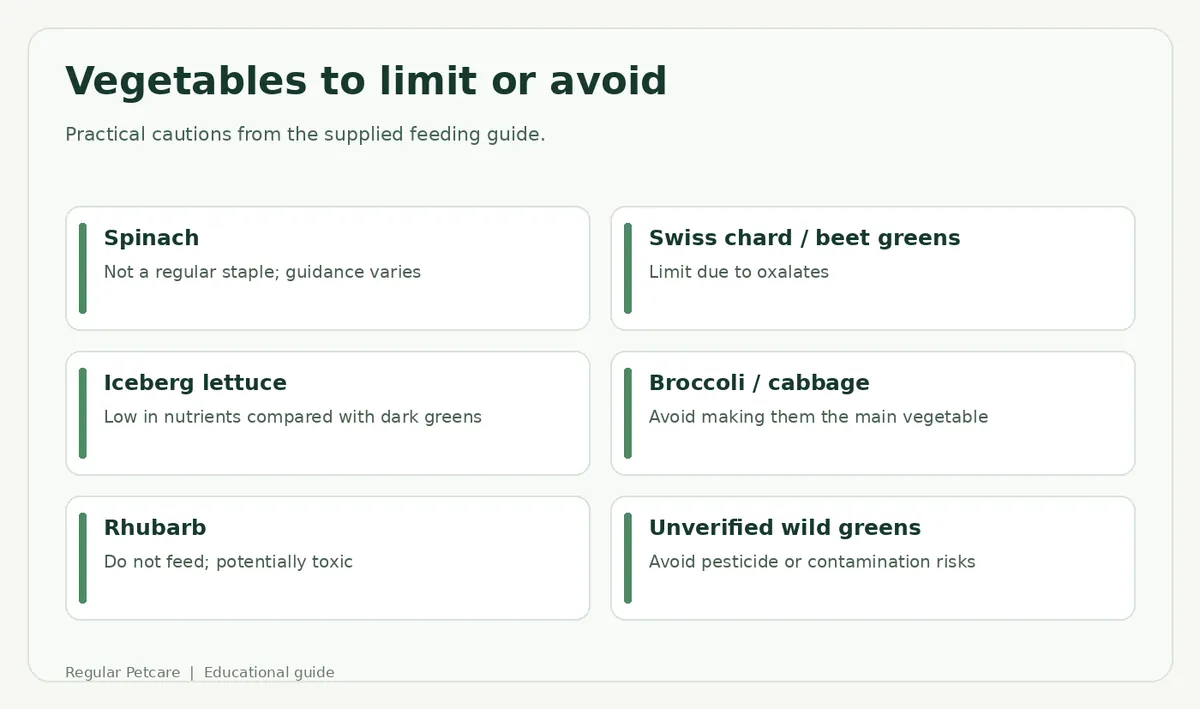
Some foods are less suitable for frequent use because of oxalates, high water content, poor nutrient density or potential toxicity. A limited food is not necessarily poisonous, but it should not crowd out better choices.
Spinach
Spinach contains oxalates that can reduce calcium availability. VCA recommends feeding it sparingly, whereas RSPCA UK advises avoiding it. With other good greens available, there is no need to use spinach as a regular staple.
Swiss Chard and Beet Greens
These greens also contain oxalates. VCA recommends limiting them, so rely mainly on preferred leafy greens instead.
Iceberg Lettuce
Iceberg lettuce contains a lot of water and comparatively fewer useful nutrients. A small amount is not usually an emergency, but it is a poor basis for an adult salad.
Broccoli and Cabbage
Some veterinary lists allow these vegetables. Other husbandry sources recommend limiting large quantities due to possible thyroid-related concerns. Evidence does not establish that every small serving is harmful; avoid relying on them heavily.
Rhubarb
Do not feed rhubarb. It has potentially toxic components. If a bearded dragon eats a potentially toxic plant, contact a reptile-experienced veterinarian promptly.
How Much Vegetables Should a Bearded Dragon Eat?
Age, health, activity, body condition and the rest of the feeding plan all matter. Young bearded dragons generally need a greater proportion of insects; plant foods become increasingly important as they grow.
| Life stage | General approach |
|---|---|
| Baby | Offer prepared greens alongside an age-appropriate insect feeding plan |
| Juvenile | Continue offering greens and vegetables as the diet gradually changes |
| Adult | Make varied leafy greens a major regular component, with appropriate insects and other vegetables |
| Senior | Adjust according to body condition, activity and veterinary advice |
NC State and Washington State University describe adult diets of approximately 70–75% plant matter and around 25% insects. These proportions should not be applied rigidly to growing animals or those with medical needs.
How to Prepare Vegetables for Bearded Dragons
- Choose fresh produce. Avoid wilted, moldy or decaying vegetables.
- Wash thoroughly. Rinse under clean running water; do not use soap or household cleaning products.
- Remove unsuitable parts. Discard hard stems, seeds or tough sections where appropriate.
- Cut into manageable pieces. Chop or grate according to the animal's size; avoid large, hard chunks.
- Mix appropriate vegetables. Combine several leafy greens with smaller amounts of other suitable vegetables.
- Serve fresh. Use a clean bowl and remove uneaten food before it spoils.
- Clean the feeding area. Wash dishes and your hands after handling the reptile or enclosure.
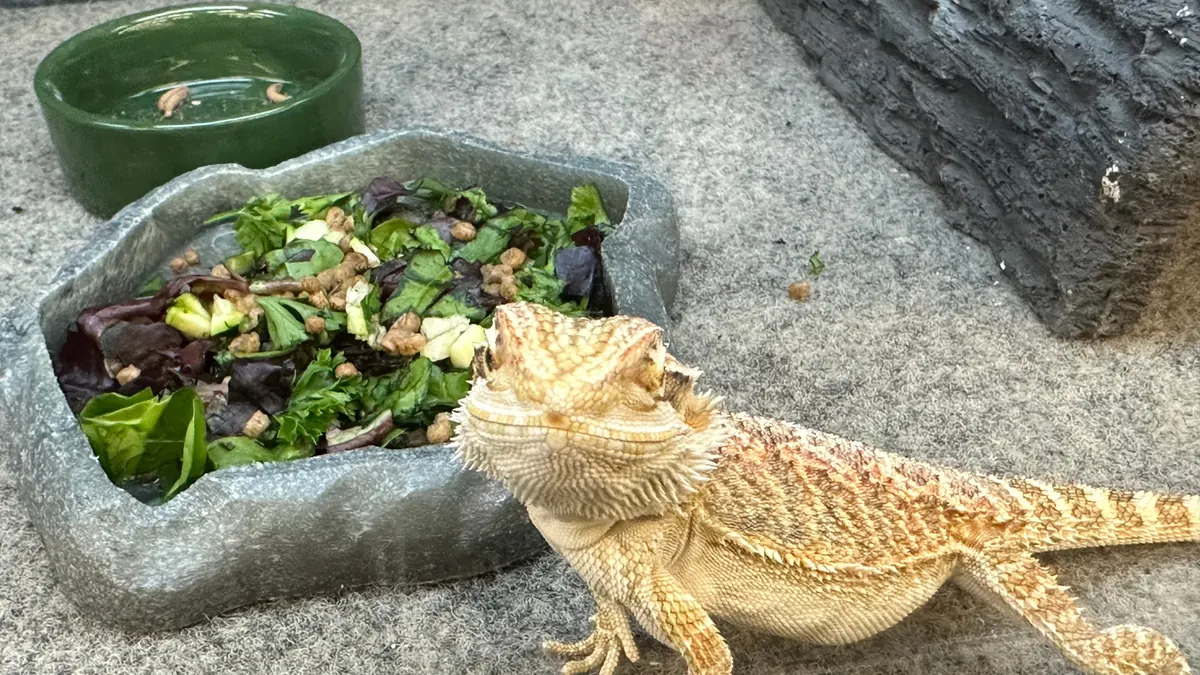
Simple Bearded Dragon Salad Ideas
These combinations are examples of variety for healthy adults, not complete meal plans or precisely balanced formulations.
Salad 1: Leafy Green Mix
- Collard greens
- Mustard greens
- Turnip greens
- A small amount of grated butternut squash
Salad 2: Colorful Vegetable Mix
- Escarole
- Dandelion greens
- Finely chopped bell pepper
- A small amount of grated carrot
Salad 3: Mixed Greens and Squash
- Collard greens
- Endive
- Watercress
- Finely chopped zucchini
Rotate the ingredients. These salads do not replace appropriate insect feeding, calcium and vitamin supplementation, or correct UVB exposure. For broader feeding information, see the diet and nutrition guides.
What If Your Bearded Dragon Won't Eat Vegetables?
Some bearded dragons, particularly younger ones, show more interest in insects. Encourage familiarity with fresh greens without withholding essential nutrition.
- Offer different fresh leafy greens consistently.
- Chop foods into suitable pieces.
- Try different textures and appropriate combinations.
- Keep a predictable feeding routine.
- Review basking temperatures and UVB provision.
- Monitor weight, appetite and activity.
Sudden loss of appetite, weight loss or persistent refusal of food may require a reptile-experienced veterinarian.
Common Mistakes When Feeding Vegetables
- Feeding only one vegetable: Rotate suitable greens to avoid an overly narrow diet.
- Offering too much lettuce: Low-nutrient lettuce should not replace darker leafy greens.
- Serving hard, oversized pieces: Chop or grate foods appropriately.
- Collecting unknown wild plants: They may be contaminated or misidentified.
- Forgetting insect nutrition: Bearded dragons remain omnivores.
- Ignoring UVB and calcium: A good salad cannot compensate for poor lighting or unsuitable supplementation.
Frequently Asked Questions
What are the best vegetables for bearded dragons?
Collard, mustard, turnip and dandelion greens, escarole, endive and watercress are good rotation options. Squash, peppers, green beans and zucchini can add variety.
What vegetables can bearded dragons eat daily?
Fresh, suitable leafy greens such as collards, mustard greens and turnip greens can be offered in a rotation, especially to healthy adults.
Can bearded dragons eat carrots?
Yes. Offer finely grated or chopped carrot as an additional vegetable, not a replacement for leafy greens.
Can bearded dragons eat cucumber?
Yes, in limited quantities. Cucumber is high in water and should not dominate the salad.
Is spinach safe for bearded dragons?
Guidance differs. VCA suggests feeding it sparingly due to oxalates, while RSPCA UK advises avoiding it. Spinach is unnecessary when other greens are available.
Can bearded dragons eat kale?
Kale appears on some veterinary lists of suitable greens, although other sources recommend limiting it. It can be part of a varied diet rather than the sole daily green.
Can baby bearded dragons eat vegetables?
Yes. Offer suitably prepared vegetables while maintaining an age-appropriate insect feeding plan.
Should bearded dragon vegetables be cooked?
Many suitable vegetables can be offered raw after washing and chopping. Some foods may be listed as cooked by veterinary sources. Do not add oils, salt or seasoning.
Can bearded dragons eat vegetables every day?
Yes. Suitable fresh greens can be offered daily. Total feeding balance depends on age, health and individual needs.
Is lettuce good for bearded dragons?
Some lettuce can be included, but iceberg lettuce is less nutrient-dense than many darker greens and is not an ideal staple.
Final Thoughts
The best vegetables for bearded dragons are not necessarily the most colorful or expensive. A varied rotation of collard greens, mustard greens, turnip greens, pesticide-free dandelion greens, escarole, endive and watercress is a useful starting point for most healthy adults.
Add smaller portions of suitable vegetables, keep offering an appropriate insect diet, and pay attention to UVB, calcium and overall husbandry. The goal is a consistent, varied feeding routine—not one perfect vegetable.
Research References
- NC State Veterinary Hospital — Bearded Dragon Feeding
- Washington State University — Bearded Dragon Husbandry
- VCA Animal Hospitals — Feeding Bearded Dragons
- RSPCA Australia — Bearded Dragon Care
- Merck Veterinary Manual — Reptile Nutrition
- ReptiFiles — Bearded Dragon Food Guide
Editorial note: This guide is based on published veterinary and reptile-husbandry resources and the supplied source document. It is not personal veterinary advice or a claim of firsthand husbandry testing.