
Table of Contents
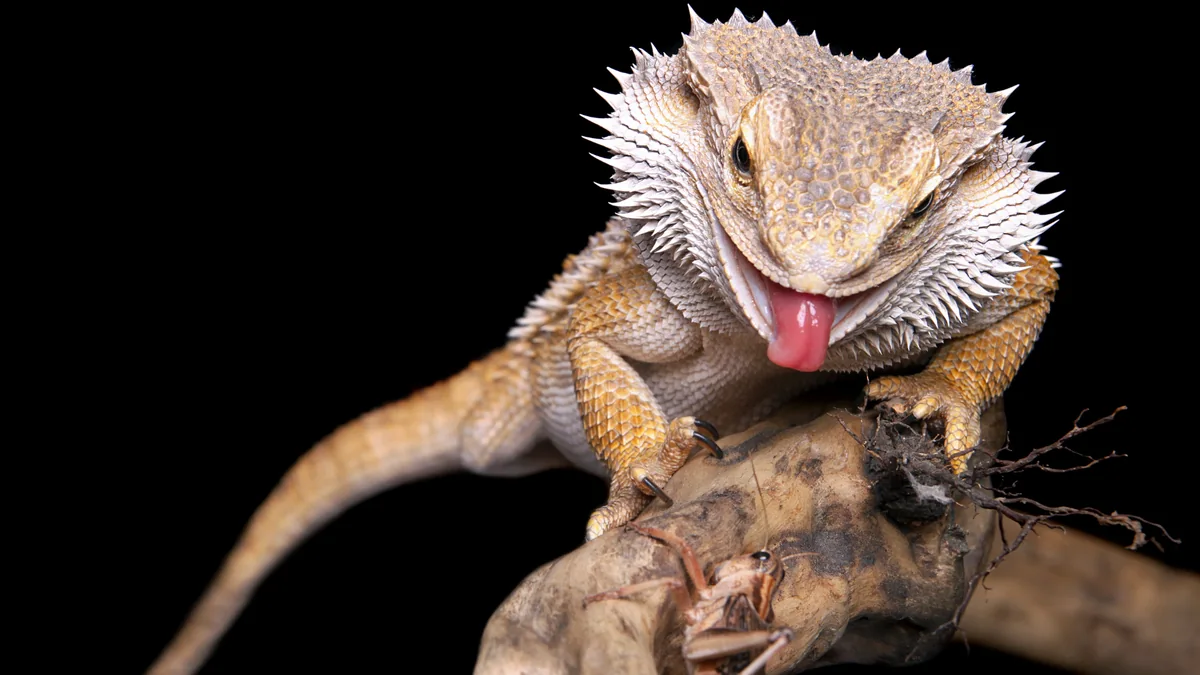
Yes, bearded dragons can bite, but they generally aren't aggressive toward people. Most bites happen when a dragon feels frightened, threatened, stressed, or mistakes a finger for food. A bite can hurt and sometimes break the skin, especially from a larger adult. However, many bites can be prevented by recognizing warning signs and using gentle handling techniques.
Bearded dragons are popular pet reptiles partly because of their generally calm nature. Still, even a usually relaxed dragon may bite when startled or uncomfortable.
If you're worried about handling a new bearded dragon—or you've already experienced a bite— understanding why it happened can help protect both you and your pet.
This guide covers how much bearded dragon bites hurt, potential health risks, first aid, warning signs, and practical ways to prevent biting.
Do Bearded Dragons Bite Humans?
Yes. Bearded dragons have teeth and can bite humans when they feel threatened or become confused during feeding.
However, biting isn't usually their first response to a stressful situation.
Many bearded dragons try to escape, flatten their bodies, puff out their beards, or open their mouths before attempting to bite.
These behaviors can serve as warning signals that the animal wants more space.
A bearded dragon that has become accustomed to calm, predictable handling may be less likely to bite, but no reptile is guaranteed never to do so.
Do Bearded Dragons Bite Often?
Bearded dragons are generally considered relatively calm pet lizards, and biting is not expected to be a routine part of normal handling.
However, there isn't a reliable universal percentage showing how frequently pet bearded dragons bite their owners.
Individual temperament, previous handling experiences, health, and environment can all influence behavior.
A newly acquired bearded dragon may react defensively because it hasn't yet become comfortable with its surroundings.
A normally calm adult may also bite unexpectedly if it becomes frightened, injured, or unwell.
The important point: A bite doesn't automatically mean your bearded dragon is aggressive. It may be communicating discomfort or reacting to a perceived threat.
Do Bearded Dragon Bites Hurt?
Yes, a bearded dragon bite can hurt. Some bites feel like a brief pinch, while stronger bites can cause punctures, bleeding, bruising, or more significant tissue damage.
How painful a bite feels depends on several factors:
- The dragon's size and jaw strength
- Where the bite occurs
- Whether the animal grips or releases quickly
- Whether its teeth break the skin
- The depth of the injury
A small juvenile may deliver a relatively minor nip, while a larger adult can cause a more painful injury.
How Strong Is a Bearded Dragon's Bite?
Bearded dragons use their jaws and teeth to grasp and process food.
Their bite strength varies with body size and anatomy, and it should not be reduced to a single universal force measurement.
Although their bites are generally less dangerous than those of much larger reptiles, their teeth can still damage human skin.
Don't test a bearded dragon's bite strength by placing a finger near its mouth.
Can a Bearded Dragon Bite Break Your Skin?
Yes. A bearded dragon's teeth can puncture or cut the skin.
Some bites leave only shallow marks, while others produce visible bleeding.
Even a small puncture wound can introduce bacteria, so any bite that breaks the skin should be cleaned promptly.
Do Baby Bearded Dragon Bites Hurt?
Baby bearded dragons have smaller jaws than adults, so their bites may be less forceful.
However, they still have teeth and can cause discomfort or minor skin injuries.
Young dragons may also mistake fingers for food or react defensively during unfamiliar handling.
Their small size doesn't make it appropriate to ignore warning signs.
Are Bearded Dragon Bites Dangerous?
Most minor bearded dragon bites are not life-threatening, but they should never be treated as completely harmless.
The main concerns are physical injury, wound infection, and exposure to germs associated with reptiles.
The CDC advises washing reptile bites immediately and seeking medical attention for serious injuries or signs of infection.
Bearded Dragon Bite Risk at a Glance
| Potential risk | What to know |
|---|---|
| Pain | Can vary from a pinch to an injury |
| Broken skin | Possible; wash promptly |
| Infection | A puncture can introduce bacteria |
| Salmonella | Reptiles can carry germs when healthy |
| Rabies | Reptiles do not transmit rabies |
| Serious injury | Uncommon but needs medical assessment |
Salmonella exposure
Reptiles can carry Salmonella even when they appear healthy
A deep puncture, significant bleeding, injury over a joint, or difficulty moving the affected area warrants medical attention.
Are Bearded Dragons Venomous?
Bearded dragons are not generally considered medically dangerous venomous animals to humans.
Research into venom-related oral glands in lizards has raised questions about the evolutionary origins and functions of their oral secretions. However, this should not be interpreted to mean that a typical pet bearded dragon bite causes dangerous venom poisoning.
For practical pet safety, tissue injury and infection are more relevant concerns.
Avoid claims that a bearded dragon bite is completely risk-free simply because serious envenomation is not expected.
Can You Get Salmonella From a Bearded Dragon Bite?
Bearded dragons can carry Salmonella bacteria, even when they appear healthy.
The CDC warns that reptiles and their environments may carry germs that can make humans sick.
Salmonella infection is commonly associated with germs entering the mouth through contaminated hands, food, or objects. A bite also creates a wound that may be exposed to bacteria.
The CDC has investigated Salmonella outbreaks associated with pet bearded dragons in the United States.
To reduce exposure:
- Wash your hands after handling a bearded dragon.
- Clean any bite or scratch immediately.
- Keep reptile equipment away from food preparation areas.
- Avoid kissing reptiles or holding them close to your face.
- Follow additional precautions for people at higher risk of serious illness.
Children younger than five should not handle reptiles, according to CDC guidance.
Can Bearded Dragons Give You Rabies?
No. Reptiles, including bearded dragons, do not get or transmit rabies.
Rabies is a disease of mammals, so a bite from a bearded dragon does not create a rabies exposure.
However, this doesn't mean a bite can be ignored. Wound care and infection prevention remain important.
Why Do Bearded Dragons Bite?
Bearded dragons usually bite because of fear, stress, feeding confusion, discomfort, or defensive behavior.
Understanding the trigger helps prevent the same situation from happening again.
1. Fear or Feeling Threatened
A bearded dragon may bite when it believes something is trying to hurt it.
Fast movements, unfamiliar people, or a hand suddenly approaching from above can cause a defensive reaction.
A dragon may also become frightened when it is cornered and cannot move away.
What helps: Approach slowly, allow the dragon to see you, and avoid trapping it in a corner.
2. Mistaking Your Fingers for Food
Bearded dragons can sometimes confuse moving fingers with insects or other food.
This may happen when someone hand-feeds frequently or reaches into the enclosure while the animal is expecting food.
The dragon may bite quickly without showing the same warning behaviors associated with fear.
What helps: Use appropriate feeding tongs and avoid placing fingers directly in front of the dragon during feeding.
3. Stress From Improper Handling
A bearded dragon may bite if someone grabs it abruptly, holds it too tightly, or restrains it when it wants to escape.
Handling can be especially stressful for a newly acquired animal that hasn't adjusted to its environment.
What helps: Support the animal's body securely and keep early handling sessions short and calm.
4. Pain or Illness
A bearded dragon that suddenly becomes defensive may be experiencing pain or another health problem.
For example, an animal with an injury may react when touched near the affected area.
Other concerning symptoms include:
- Reduced appetite
- Swelling or visible injury
- Unusual weakness
- Difficulty moving
- Changes in stool or urination
- Mouth swelling or discharge
If biting begins suddenly alongside abnormal behavior, arrange an examination with a reptile veterinarian.
5. Territorial or Reproductive Behavior
Some adult bearded dragons become more reactive during periods of reproductive activity.
Head bobbing, beard darkening, and defensive postures may occur.
These behaviors do not always lead to biting, but they can indicate increased arousal or discomfort with an interaction.
Avoid provoking the dragon or forcing handling when it displays defensive behavior.
6. Poor Enclosure Conditions
Incorrect heating, inadequate hiding spaces, constant disturbance, or other husbandry problems may contribute to stress.
A bearded dragon needs an appropriate temperature gradient, UVB lighting, secure hiding areas, and enough space to move comfortably.
Review the enclosure setup if biting occurs repeatedly.
An uncomfortable animal may become more defensive when handled.
7. Competition With Other Bearded Dragons
Bearded dragons are generally solitary animals and may bite other dragons during territorial disputes.
Housing them together can lead to fighting, injury, and competition for resources.
Providing separate, properly equipped enclosures is the safer approach for ordinary pet care.
Signs a Bearded Dragon Might Bite
| Warning sign | Suggested response |
|---|---|
| Dark beard | Give space and observe |
| Hissing or threatening open mouth | Stop approaching |
| Flattened body | Reduce stress |
| Backing away | Allow retreat |
| Lunging | Withdraw calmly |
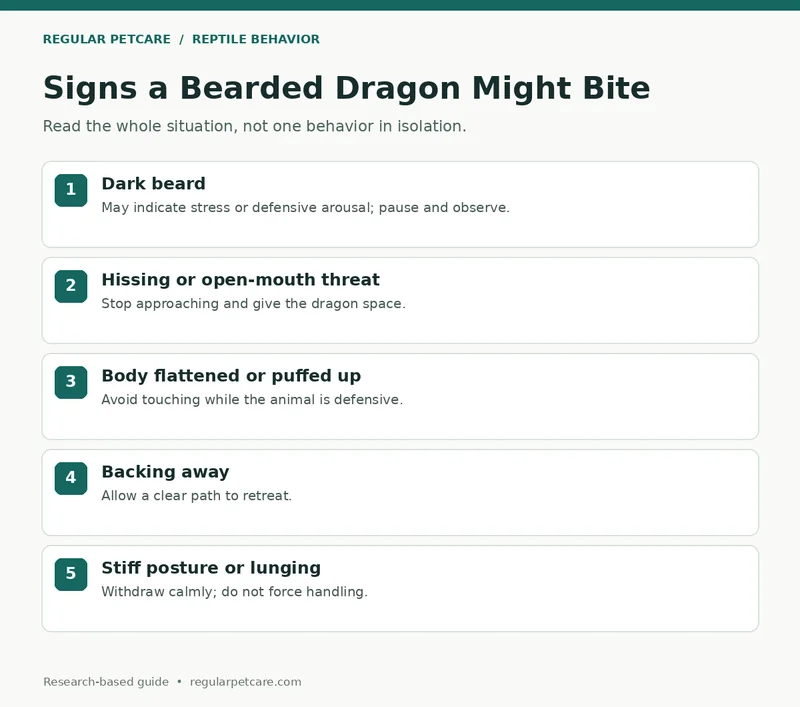
Bearded dragons often show defensive body language before biting.
Recognizing these signals can help you avoid an unnecessary confrontation.
Dark or black beard Stress, arousal, or defensive behavior Give the dragon space
Mouth opening toward a perceived threat Defensive display Stop approaching
Hissing The animal feels threatened Avoid handling
Flattened or puffed-up body Defensive posture Reduce the source of stress Backing away Attempting to escape Allow it to retreat
Stiff posture Heightened alertness Observe before interacting Lunging toward the hand Possible imminent bite Withdraw calmly
These signals are contextual.
For example, bearded dragons also open their mouths while basking to help regulate body temperature. An open mouth during relaxed basking is not automatically a threat.
Likewise, a dark beard can occur for several reasons and should be interpreted alongside the animal's other behaviors.
What to Do If a Bearded Dragon Bites You
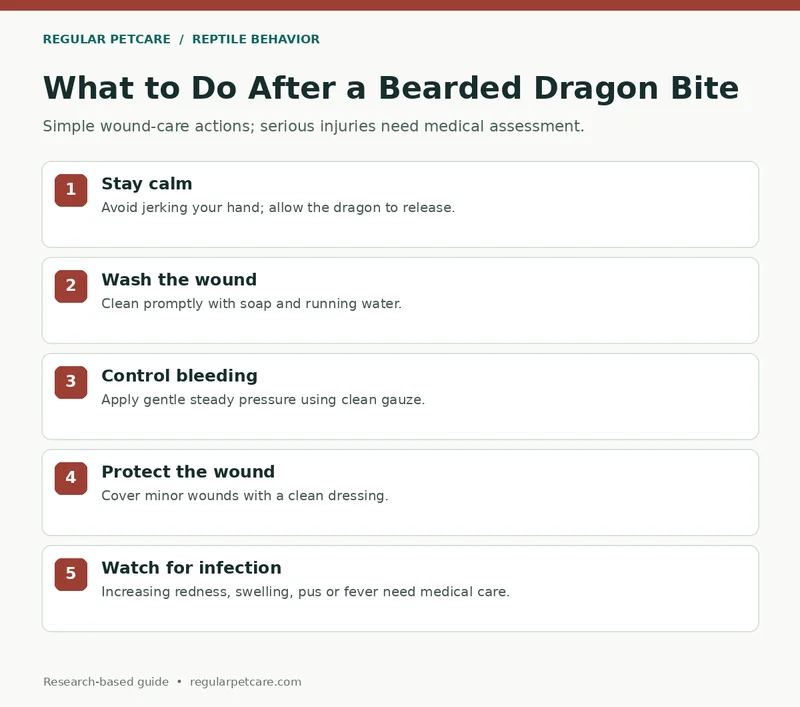
If a bearded dragon bites you, stay calm, safely disengage from the animal, and clean the injury immediately.
Avoid sudden movements that could worsen the wound or injure the dragon.
Step 1: Stay Calm and Avoid Pulling Forcefully
If the dragon is still holding onto your finger or hand, avoid jerking it away.
Forceful pulling may worsen tissue damage and can also injure the animal.
Keep the animal supported and minimize movement while allowing it to release.
Do not squeeze the dragon's jaw, shake it, or attempt to punish it.
If it remains attached or you cannot disengage safely, seek appropriate professional assistance rather than forcing the mouth open.
Step 2: Wash the Bite With Soap and Water
As soon as the animal releases, wash the affected area thoroughly with running water and soap.
The CDC recommends immediate cleaning because reptile bites can introduce germs.
Pay attention to the entire injured area, including small punctures or scratches.
Don't assume a tiny wound is clean simply because it isn't bleeding.
Step 3: Control Any Bleeding
If the wound is bleeding, apply steady pressure with a clean cloth or sterile gauze.
For minor wounds, bleeding may stop relatively quickly.
If bleeding is heavy, uncontrolled, or accompanied by severe pain or impaired movement, seek emergency medical attention.
Step 4: Cover the Wound
After cleaning a minor wound, cover it with a clean bandage.
For a superficial injury, an over-the-counter antibiotic ointment may be appropriate if you can use it safely and follow the product instructions.
Don't attempt to close a deep bite wound at home.
A healthcare professional should evaluate deep punctures, badly torn skin, or injuries involving joints.
Step 5: Watch for Infection
Over the following days, watch for signs that the wound is becoming infected.
These can include:
- Increasing redness
- Swelling or warmth
- Worsening pain
- Pus or unusual drainage
- Fever or feeling unwell
- Red streaking extending from the wound
Seek prompt medical assessment if these symptoms develop. Red streaking, rapidly spreading redness, or systemic illness calls for urgent evaluation.
Step 6: Check Whether You Need Medical Care
Contact a healthcare professional promptly if:
- The bite caused a deep puncture or significant tissue damage.
- The injury involves a finger, hand joint, tendon, or another sensitive area.
- Bleeding doesn't stop with pressure.
- You experience numbness or difficulty moving the affected area.
- The wound shows signs of infection.
- You have diabetes, a weakened immune system, or another condition that increases
- infection risk.
- Your tetanus vaccination may not be up to date.
A medical professional can determine whether wound treatment, antibiotics, or a tetanus booster is appropriate.
When Is a Bearded Dragon Bite an Emergency?
Seek emergency care for uncontrolled bleeding, severe injury, loss of movement or sensation, or serious allergic symptoms such as difficulty breathing or swelling of the face or throat.
Never delay medical treatment because a bite came from a relatively small pet reptile.
How to Prevent Bearded Dragon Bites
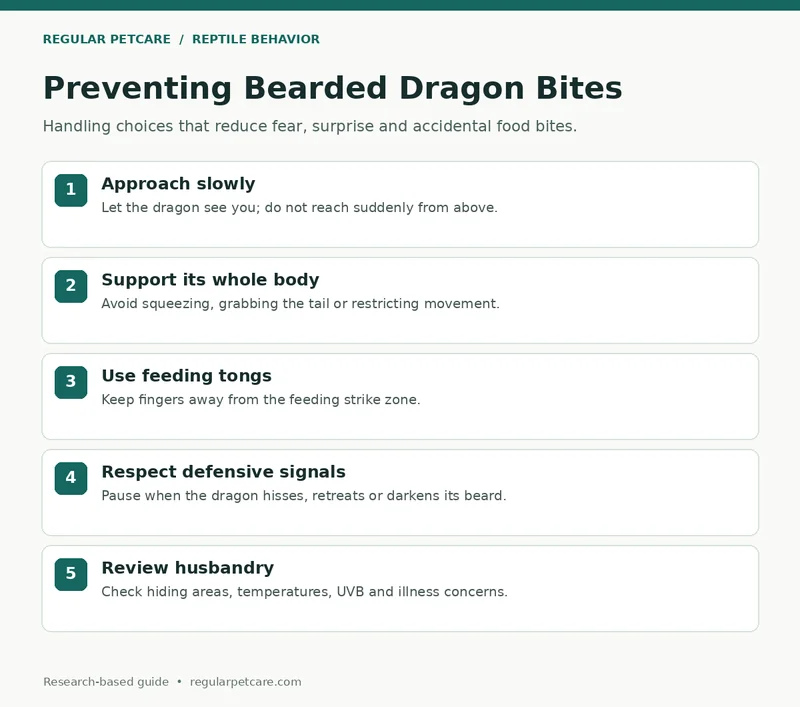
Most bite prevention comes down to understanding the dragon's behavior and making handling predictable and comfortable.
1. Approach From the Side, Not Suddenly From Above
Allow the dragon to notice your hand before you attempt to pick it up.
Move slowly and avoid sudden shadows or movements that could startle it.
Don't corner the animal or chase it around the enclosure.
2. Support the Entire Body
When picking up a bearded dragon, support its chest, abdomen, and hindquarters.
Keep the body relatively level and avoid restricting breathing.
Don't lift the dragon by its tail, legs, or head.
Never force it onto its back.
3. Start With Short Handling Sessions
A newly acquired dragon may need time to adjust to its enclosure before regular handling.
Begin with brief, calm interactions that the animal tolerates.
Watch for signs that it wants to retreat.
Gradually increase handling only when the dragon remains comfortable.
4. Use Feeding Tongs
Feeding tongs can reduce accidental finger bites.
Choose an appropriate tool, present food carefully, and keep your fingers away from the animal's mouth.
Avoid teasing the dragon with food or encouraging it to chase your hand.
5. Respect Warning Signs
If the dragon hisses, retreats, darkens its beard, or displays a defensive open mouth, stop the interaction.
Give it an opportunity to settle.
Repeatedly pushing past warning signs may make handling more stressful and increase the risk of biting.
6. Maintain Appropriate Husbandry
Review the enclosure's heating, UVB lighting, hiding areas, diet, and cleanliness.
Husbandry problems can contribute to stress and illness.
A suitable environment supports better welfare, although it cannot guarantee that an animal will never bite.
7. Never Punish Biting
Don't hit, tap, yell at, or shake a bearded dragon after a bite.
Punishment can frighten or injure the animal and make future handling more difficult.
Instead, identify what triggered the reaction and change the interaction.
How to Handle a Bearded Dragon Safely
Safe handling helps protect both the animal and the person holding it.
Follow this simple routine:
1. Wash your hands before handling, especially after touching food or other animals. 2. Approach calmly and make sure the dragon can see you. 3. Watch for signs of stress or defensive behavior. 4. Support the body with both hands when appropriate. 5. Keep the animal close to a safe surface to reduce fall risk. 6. Avoid touching its face or restricting its movement unnecessarily. 7. Return it to the enclosure if it becomes distressed. 8. Wash your hands thoroughly afterward.
Keep reptiles away from your mouth and face.
Children younger than five should not handle bearded dragons because of the risk of Salmonella exposure. Older children need appropriate adult supervision.
Why Is My Bearded Dragon Suddenly Biting Me?
A sudden change in behavior deserves attention, especially if your dragon was previously comfortable with handling.
Start by considering whether something changed recently.
Has the enclosure been moved? Is a new person handling the dragon? Have feeding routines or environmental conditions changed?
Sometimes biting follows a frightening experience. In other cases, it may be related to pain, illness, reproductive behavior, or poor husbandry.
If the change is unexplained or accompanied by appetite loss, weakness, injury, or other symptoms, arrange a reptile veterinary examination.
Don't assume your pet has simply developed a bad personality.
Do Bearded Dragons Bite Their Owners?
Yes, bearded dragons can bite familiar people, including their regular caregivers.
A dragon that is usually relaxed may still react if startled, handled during an uncomfortable moment, or confused by food-related movements.
Being familiar with a person can help reduce stress, but it doesn't remove the animal's natural defensive responses.
Instead of relying on familiarity alone, pay attention to body language every time you interact.
Do Bearded Dragons Bite Children?
Yes, bearded dragons can bite children, particularly when handled roughly or unexpectedly.
Children may move quickly, grip too tightly, or overlook warning signs.
However, biting isn't the only concern.
The CDC recommends that children younger than five should not handle reptiles because they are more vulnerable to serious illness from Salmonella.
Older children should handle bearded dragons only with suitable supervision and proper hygiene.
Can a Bearded Dragon Bite Another Pet?
Yes. A bearded dragon may bite another animal if it feels threatened or attempts to defend itself.
Interactions with dogs, cats, and other household pets can also be dangerous to the bearded dragon.
Even a normally calm dog or cat can injure a reptile in a sudden movement.
Keep other pets physically separated from your dragon rather than allowing direct interactions.
Frequently Asked Questions
Do bearded dragons bite their owners?
Yes, bearded dragons can bite their owners, although they are generally calm pets. Most bites occur when the animal feels frightened, stressed, uncomfortable, or mistakes fingers for food. Familiarity can reduce stress, but it doesn't eliminate bite risk.
Does a bearded dragon bite hurt?
Yes. A bite may feel like a pinch or cause more significant pain, depending on the dragon's size and the bite location. Stronger bites can break the skin or cause bleeding. Clean any wound immediately.
Are bearded dragon bites poisonous?
Bearded dragons are not considered dangerously venomous to people under ordinary pet- handling circumstances. The more relevant concerns are physical injury and infection. Any bite that breaks the skin should be cleaned, and serious wounds require medical attention.
Can a bearded dragon bite draw blood?
Yes. A bearded dragon's teeth can puncture or cut human skin, causing bleeding. Wash the injury with soap and water, apply pressure if needed, and cover a minor wound. Seek medical care for deep or serious injuries.
Why does my bearded dragon try to bite me?
Common reasons include fear, stress, feeding confusion, pain, and uncomfortable handling. A sudden change in biting behavior may also signal illness. Review the environment and handling routine, and consult a reptile veterinarian if you notice other symptoms.
What should I do if my bearded dragon bites me?
Remain calm, avoid pulling forcefully, and allow the dragon to release. Wash the injury with soap and water, control any bleeding, and cover minor wounds. Seek medical care for deep bites, signs of infection, or significant injury.
Do baby bearded dragons bite?
Yes. Baby bearded dragons can bite when frightened or when they mistake fingers for food. Their bites may be less forceful than those of adults, but they can still cause discomfort. Handle young dragons gently and avoid startling them.
Can a bearded dragon bite cause an infection?
Yes. Reptile bites can introduce germs into broken skin. Watch for increasing redness, swelling, warmth, pain, or discharge. Seek medical attention if these symptoms develop or if the wound is deep or otherwise concerning.
Can you get rabies from a bearded dragon bite?
No. Bearded dragons are reptiles, and reptiles do not get or transmit rabies. However, their bites can still cause tissue damage or introduce bacteria, so proper wound cleaning and medical care remain important.
How do I stop my bearded dragon from biting?
Identify the cause of the biting, approach calmly, use feeding tongs, support the body during handling, and respect defensive signals. Avoid punishment. If biting appears suddenly or frequently alongside signs of illness, arrange a reptile veterinary check.
Final Thoughts
Research Sources and Further Reading
- CDC — Reptiles and Amphibians: Healthy Pets, Healthy People
- CDC — Salmonella Outbreak Linked to Pet Bearded Dragons
- Mayo Clinic — Animal Bites: First Aid
- Merck Veterinary Manual — Special Considerations for Reptiles
- New York State Department of Health — Rabies
Editorial note: Regular Petcare publishes research-based educational content. This article is not a substitute for medical advice, and it does not claim personal ownership, first-hand testing, or veterinary review.