
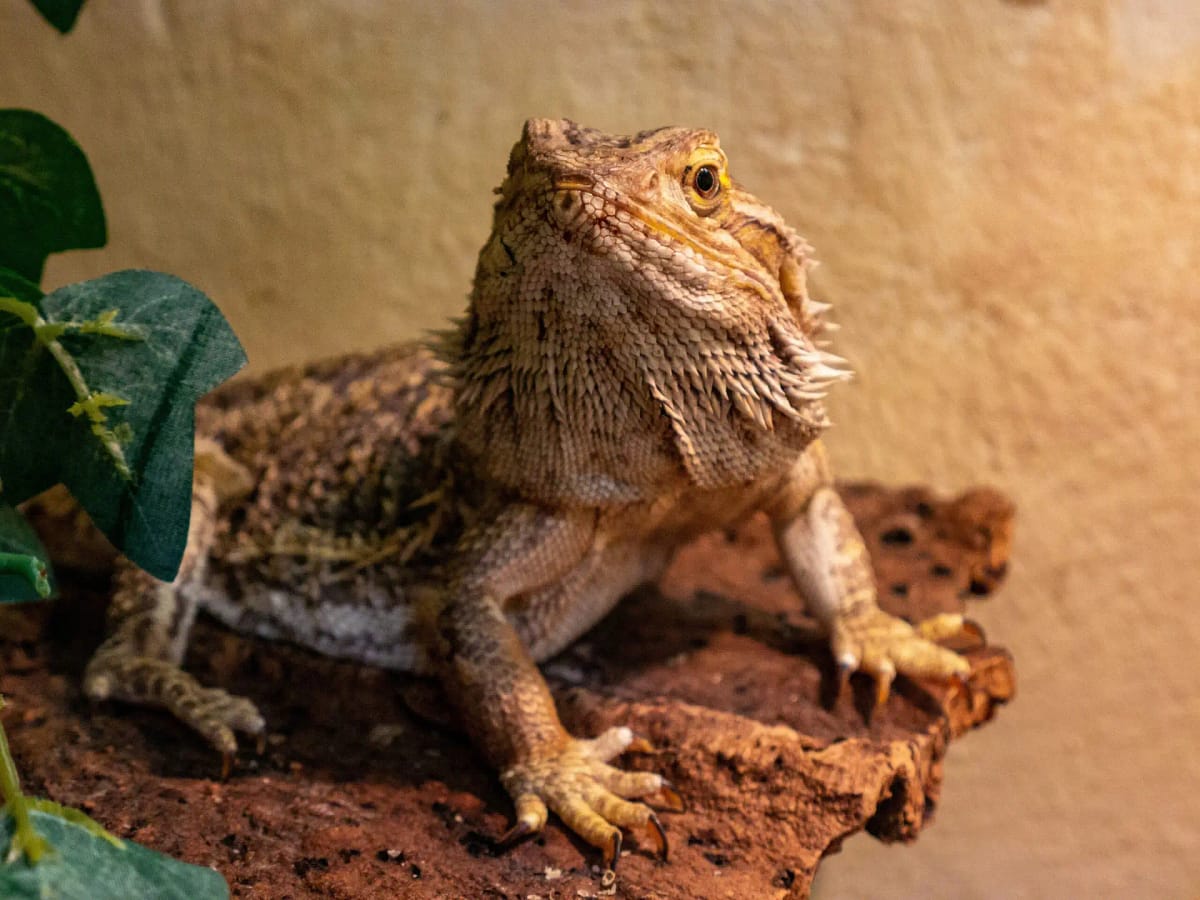
A proper habitat is one of the most important parts of keeping a healthy bearded dragon. The enclosure needs enough space, the right heat and UVB, good ventilation, and a layout that gives your dragon room to bask, cool down, hide, and move around.
For a single adult, that means an enclosure of at least 4 × 2 × 2 ft (roughly 120 gallons), a basking surface around 100–110°F with a cool end around 75–85°F, a linear T5 HO UVB tube over the basking end, low humidity, a safe substrate, two hides, a basking platform, climbing structures, a shallow water dish, and digital thermometers to confirm the numbers.
This guide explains what each part does, how the pieces fit together, and what to buy. It’s written for beginners setting up a first enclosure and for existing owners checking whether their current setup holds up.
A note on the author: this article is research-based, written by a pet and reptile researcher rather than a veterinarian. Where reputable sources disagree on a number, that disagreement is flagged rather than smoothed over. For anything involving your animal’s health, talk to a qualified reptile or exotic-animal veterinarian.
What you’ll learn
- Bearded dragon habitat requirements
- Tank size and enclosure options
- Tank setup and equipment
- Temperature and UVB
- Humidity and substrate
- Accessories and décor
- Baby vs. adult habitat
- Setup checklist and common mistakes
Bearded Dragon Habitat Requirements
A bearded dragon needs an enclosure that lets it do three things every day: warm up, cool down, and hide.
Everything else supports those three behaviors. Bearded dragons are ectotherms — they can’t generate their own body heat. They regulate temperature by moving: toward the heat when they need to digest and be active, away from it when they’ve had enough. An enclosure that offers only one temperature takes that control away from them.
The full requirement list:
- An enclosure large enough to hold a real temperature gradient — a hot end and a cool end that are meaningfully different
- An overhead basking heat source creating a defined warm spot
- Linear UVB lighting positioned over the basking area
- A safe substrate the animal can walk on without injury or ingestion risk
- At least two hides, one warm and one cool
- Elevated basking surfaces and climbing structures
- A shallow water dish and a feeding area
- Accurate digital thermometers and a hygrometer
- A secure lid or door and good ventilation
Where these requirements come from. The pet trade’s bearded dragon is almost always the central (inland) bearded dragon, Pogona vitticeps. The Australian Museum describes its habitat as arid to semi-arid woodland, shrubland, and hummock grassland across the semi-arid interior of eastern Australia and lists the species as both arboreal and terrestrial. Three details from that environment directly shape the captive setup:
- They are heliothermic sun-baskers. They spend a large part of the day shuttling between sun and shade to hold a preferred body temperature. A single ambient temperature doesn’t give them that option.
- They are semi-arboreal. The NSW Department of Education notes they like to get off the ground and are often seen perched on fence posts, logs, and rocks. That’s the case for elevated basking platforms and climbing branches, not just floor space.
- They burrow and shelter. During extreme heat or at night, they retreat underground or into cover. Hides give them a way to do the same thing in captivity.
The daily temperature swing in their range is wide, which is why a nighttime drop in the enclosure is normal rather than a problem.
Bearded dragon habitat at a glance
| Habitat element | General requirement | Why it matters |
| Enclosure size (adult) | 4′ L × 2′ W × 2′ H minimum (~120 gal); larger is better | Space is what makes a working temperature gradient possible |
| Enclosure size (hatchling) | 20–40 gal acceptable short term; many keepers start adult-sized | Very small dragons can struggle to find food in large spaces |
| Basking surface temp | 100–110°F (38–43°C) working target; published figures range from 90°F to 115°F | Drives digestion, appetite, and normal activity |
| Cool side temp | About 75–85°F (24–29°C) | Gives the animal somewhere to shed heat |
| Night temp | A natural drop is normal; supplemental heat rarely needed above ~65°F | Mimics the wide day–night swing of inland Australia |
| UVB | Linear T5 HO tube, mounted over the basking zone, replaced on schedule | Enables vitamin D3 production and calcium absorption |
| Photoperiod | Roughly 10–14 hours of light daily, on a timer | Supports normal daily and seasonal rhythms |
| Humidity | Low — most sources cite 20–40%; some husbandry references allow up to 60% | Sustained damp air raises respiratory and skin disease risk |
| Substrate | Solid surfaces are the safest default; loose substrate is debated | Affects ingestion risk, hygiene, and natural digging behavior |
| Hides | Minimum two — one warm, one cool | Lets the animal escape light and heat without giving up warmth |
| Water | Shallow dish, kept clean, away from the basking lamp | Hydration without flooding the enclosure with humidity |
| Ventilation | Screen top or vented panels; never sealed | Stale, humid air is a leading husbandry failure |
These are starting targets. Verify them against your own equipment and, ideally, a reptile vet familiar with your animal.
For their range, climate, and wild behavior, see our guide to the bearded dragon’s natural habitat in the wild.
Bearded Dragon Tank Size
A single adult bearded dragon needs a minimum of 4 feet long × 2 feet wide × 2 feet tall — about 120 gallons. Bigger is better as long as the heating and lighting are scaled to match.
That figure is the current practical baseline among experienced keepers and many reptile veterinarians, though published guidance varies:
- ReptiFiles states that leading modern husbandry experts recommend no smaller than a 120-gallon (48″ × 24″ × 24″) enclosure, preferably larger.
- VCA Animal Hospitals recommends a 60- to 100-gallon tank or larger for a grown animal, with enclosure length at least three times the lizard’s total body length and width of at least 16 inches so it can turn around comfortably.
- The NSW Department of Education states that an adult inland bearded dragon should never be kept in an enclosure less than 120 cm long and 60 cm wide — almost exactly the 4′ × 2′ footprint — and that juveniles don’t need a smaller enclosure than adults.
- The RSPCA gives 120 cm long × 60 cm high × 60 cm deep as the minimum for a single adult.
- The Merck Veterinary Manual uses a formula: 0.2 m² of floor space per 10 cm of total length for terrestrial lizards. For an adult at 50–55 cm, that works out to roughly 1.0–1.1 m² — more than a 4 × 2 ft footprint (0.74 m²).
Older care sheets and pet-store starter kits still push 20- and 40-gallon tanks for adults. The Australian Museum lists the species at about 55 cm (22 inches) total length, and adults commonly reach 16–24 inches including tail. In a 3-foot tank, the hot end and cool end sit too close together to stay separate, and the gradient collapses.
Floor space beats gallons. Aquarium ratings measure water volume, not usable layout. A tall 40-gallon tank and a long 40-gallon tank are not the same habitat. Measure length and width first.
Height still counts. Two feet of height gives room to raise a basking platform toward the UVB source without putting the animal dangerously close to the bulb.
For a full breakdown by age, gallon conversions, and upgrade timing, see our bearded dragon tank size guide.
Best Bearded Dragon Enclosure
For most keepers, the best bearded dragon enclosure is a front-opening PVC or wood vivarium of at least 4 × 2 × 2 ft with secure doors and real ventilation. Glass works if the footprint is right and you can hold the heat; screen-sided cages don’t work at all.
The material changes how the habitat behaves, not how much space is required.
- Glass terrariums are widely available and easy to disinfect, but the Merck Veterinary Manual notes that glass is a poor insulator, that the resulting heat loss can cause large temperature swings, and that bearded dragons do better in larger wooden or fiberglass vivaria than in glass aquaria. Front-opening glass models are less stressful to work in than top-opening ones, since reaching down from above mimics a predator.
- PVC enclosures hold heat well and are lightweight for their size. Their tighter build means you should watch ventilation and humidity more actively.
- Wood or melamine vivariums insulate well, which suits an arid species, but they need proper sealing to survive cleaning and spills.
- Screen or mesh-sided cages are not suitable as a primary enclosure. They can’t hold a basking temperature, and the mesh itself can injure feet and claws.
What to look for. When choosing a bearded dragon enclosure, check for:
- Minimum 4 × 2 × 2 ft footprint
- Front-opening access
- Adequate ventilation
- Secure doors
- Easy access for lighting and heating
- Enough height for proper basking and UVB placement
Don’t trade ventilation for heat retention. Merck warns that reducing airflow to hold temperature or humidity frequently causes skin and respiratory disease; if the enclosure runs cold, fix the heating instead.
Compare enclosures that meet all six criteria in our Best Bearded Dragon Enclosures roundup. For layout inspiration, see our bearded dragon enclosure ideas gallery, or build your own with the DIY bearded dragon enclosure guide.
Bearded Dragon Tank Setup
Think of the enclosure as three zones running along its length: a basking zone at one end, a cool zone at the far end, and a transition zone in the middle. Keep enough open floor in that middle zone for walking, foraging, and normal movement. Heat, light, hides, and dishes all have a place in this layout, and putting them in the right place matters as much as buying the right equipment.
Basking Area
Put the heat lamp and the UVB fixture over the same end so heat and UV overlap. In nature, warmth and ultraviolet light come from the same source. If your dragon has to choose between them, it gets less of one.
The basking area should be the brightest, hottest part of the enclosure, with the target temperature measured on the surface the animal sits on rather than the air around it. Everything else in the layout is arranged relative to this spot.
Cool Side
The far end is the retreat: a hide, shade, lower light levels, and the water dish. It needs to sit meaningfully cooler than the basking end so the animal can shed heat when it’s had enough. If the cool side isn’t clearly cooler, the enclosure is too short or the lamp is too strong for it — either way the gradient has collapsed and the animal can’t regulate itself.
Warm Hide and Cool Hide
Hides go at both ends. A warm hide lets the animal stay warm while feeling covered. A cool hide lets it escape both light and heat. With only a cool hide, it has to choose between warmth and cover.
Basking Platform
Place an elevated platform — flat rock, slate, cork, or a sturdy branch — under the lamp, positioned so the basking surface sits at the distance your UVB bulb’s manufacturer chart recommends. Raising the platform brings the animal closer to both the heat and the UV source; raising it too far risks a burn or overexposure. Measure the distance from the bulb to the platform surface rather than eyeballing it.
Food and Water Area
The water dish belongs on the cool side, away from the basking lamp — a warm dish evaporates constantly and drives enclosure humidity up. Feed greens from a shallow dish rather than directly on the substrate, and keep the feeding area away from the spot where the animal typically defecates. Both get cleaned promptly.
Then verify with a thermometer, not a guess. Stick-on dial gauges are widely considered unreliable. Use a digital probe thermometer placed on the basking surface, plus an infrared temperature gun to spot-check surfaces — VCA suggests the same combination. Run the whole setup for several days before the animal moves in — the RSPCA recommends at least a week — and watch what the temperatures actually do across morning, afternoon, and night.
Step-by-step assembly order and a printable starter list are in our bearded dragon tank setup guide.
Bearded Dragon Habitat Shopping List
Everything above comes down to a fairly short list of equipment. This is the core setup; the checklist near the end of the article covers the full pre-arrival run-through.
| What you need | Recommended setup | Our picks |
| Enclosure | 4 × 2 × 2 ft or larger | Best Bearded Dragon Enclosures |
| UVB light | Linear T5 HO | Best UVB Bulbs for Bearded Dragons |
| Basking lamp | Overhead heat source | Habitat products guide |
| Thermostat/dimmer | For heat control | Habitat products guide |
| Thermometer | Digital probe + IR gun | Best Thermometers for Bearded Dragons |
| Hygrometer | Digital | Best Thermometers for Bearded Dragons |
| Substrate | Tile/stone or suitable alternative | Best Substrate for Bearded Dragons |
| Hides | Warm + cool | Habitat products guide |
| Basking platform | Stable elevated surface | Habitat products guide |
| Food & water dishes | Shallow and easy to clean | Habitat products guide |
Add a plug-in timer for the lights and you have the complete kit. The sections below explain how to choose and position each item.
See our recommended bearded dragon habitat products for specific picks in each category.
Bearded Dragon Temperature
Aim for a clearly defined basking surface at one end and a cooler area at the opposite end. Measure the surface temperature where your dragon actually sits, not just the surrounding air — a lamp can produce 90°F air while the rock beneath it reads 105°F, and that gap is part of why published ranges look so inconsistent.
Basking Temperature
Published basking figures run from about 90°F to 115°F depending on the source and on whether it describes air or surface temperature. VCA gives a warm end of 90–100°F. The Merck Veterinary Manual lists a preferred air-temperature zone of 77–90°F for the species, with basking about 5°C (9°F) warmer than that. UC Davis’s veterinary care sheet gives a basking spot of 88–95°F. Husbandry sources that measure the surface itself run hotter: the RSPCA targets a basking zone of 38–42°C (100–108°F) with the thermostat probe at the animal’s level, and ReptiFiles recommends a basking surface of 105–115°F.
A surface reading of 100–110°F, confirmed with a probe, sits inside that spread and is the working target this guide uses. Juveniles are often kept a few degrees warmer.
Control the lamp with a thermostat or dimmer rather than relying on bulb wattage alone — the RSPCA says a thermostat must be used with every heat source. Never use heat rocks as a primary heat source: Merck notes they frequently cause burns and should be avoided, and VCA advises placing heat sources outside and above the basking end so the animal can’t contact them.
Cool Side Temperature
The cool end should sit around 75–85°F (24–29°C) — well below the basking spot. VCA gives 75–80°F, the NC State Veterinary Hospital 75–85°F, and ReptiFiles 70–85°F. Confirm it with a second thermometer, then watch behavior. A dragon that sits under the lamp all day gaping and never leaves may be too cool. A dragon that avoids the basking spot entirely is probably too hot. Either way, the setup isn’t working.
Nighttime Temperature
A drop after lights-out is normal and healthy; Merck describes a fall of about 5°C at night as typical. VCA notes overnight temperatures in the roughly 65–80°F range are acceptable as long as the cool end stays there, while UC Davis and NC State give 70–75°F and the RSPCA says not below 20–22°C (68–72°F). If your room stays above about 65°F, supplemental night heat usually isn’t needed. If it doesn’t, use a non-light-emitting source such as a ceramic heat emitter on a thermostat. Skip colored “night bulbs” – they emit visible light and disrupt sleep.
Full gradient targets by age, wattage guidance, and thermostat setup: bearded dragon temperature guide.
Bearded Dragon UVB Lighting
Bearded dragons need daily UVB from a linear T5 HO fluorescent tube mounted over the basking end, with the basking surface set at the distance the bulb manufacturer specifies. The Merck Veterinary Manual describes UVB in the 290–300 nm band as essential for diurnal lizards because it drives vitamin D3 synthesis and calcium regulation, and it attributes the calcium and D3 deficiency common in pet reptiles largely to poor-quality lighting and low-calcium diets. UC Davis states plainly that UVB is required to maintain bearded dragons. Without it, a dragon can’t use dietary calcium properly and is at risk of metabolic bone disease.
Best UVB Bulb for Bearded Dragons
Linear tubes are strongly preferred over compact or coil bulbs. A coil produces a narrow cone of UV and leaves most of the enclosure as a dead zone; a linear tube produces a usable band of light the animal can move in and out of. T5 high-output (HO) tubes are the current standard — ReptiFiles specifies a T5 HO desert tube such as the Arcadia 12% or Zoo Med ReptiSun 10.0, aiming for a UV Index of roughly 4.0–4.5 at the basking spot.
Replace on schedule. UV output decays long before the bulb stops emitting visible light. Intervals vary by bulb type: Merck gives 9–12 months for fluorescent UV lamps, UC Davis advises every 3–6 months, and most T5 HO manufacturers rate their tubes for about 12 months. Follow your manufacturer’s interval and set a calendar reminder, because a spent UVB bulb looks identical to a working one.
UVB Distance and Placement
- Mount the tube over the same end as the heat lamp. The RSPCA recommends a high-output 10–12% tube up to half the vivarium length, fixed into the roof as far into the hot end as possible; other guidance goes to two-thirds. Either way the goal is a gradient — the RSPCA specifies a UV Index of 3.0–5.0 in the basking zone falling to zero in the shade — with a UV-free retreat at the far end. The shaded end is intentional.
- Follow the distance chart. UVB output falls off sharply with distance. Merck and UC Davis both give a generic limit of about 12 inches for fluorescent tubes; stronger T5 HO tubes are placed farther — ReptiFiles puts the basking area 11–13 inches below a T5 HO tube mounted over mesh and 16–19 inches below one mounted inside. Always use your specific bulb’s chart.
- Compensate for mesh. A standard metal screen top blocks a substantial share of UVB; ReptiFiles’ placement guidance assumes roughly 45% blockage, and other estimates start around 30%. Either mount the fixture inside the enclosure or reduce the distance to compensate.
- Glass blocks UVB. Merck notes that most transparent plastic and glass barriers filter out UVB. A window does not count as UVB exposure. Neither does a glass or plastic guard over the fixture.
How Long Should UVB Be On?
Roughly 10–14 hours of light per day, on a timer, with a genuine dark period at night. Merck lists a 12-hour photoperiod as suitable for general maintenance; UC Davis suggests about 14 hours of daylight and 10 of darkness. Consistency matters more than hitting an exact number.
Bulb selection, mounting distances, and mesh compensation: bearded dragon UVB lighting guide.
Bearded Dragon Humidity
Bearded dragons come from a dry climate, and their enclosure should stay dry too. Published targets vary more than most care sheets admit, but every source agrees on the direction: consistently damp air is the greater risk.
Ideal Humidity for Bearded Dragons
The Merck Veterinary Manual lists 20–30% for the species, noting that requirements rise substantially during shedding. The NC State Veterinary Hospital gives 20–40%. The RSPCA and many husbandry references cite 30–40%, and ReptiFiles allows an average of 30–60%, warning that levels consistently above 60% can make a dragon sick.
No single number is settled, so don’t chase one. Keep the enclosure in the 20–40% band most sources recommend, treat readings consistently above 50–60% as a problem to fix, and accept normal daily fluctuation. Persistent damp conditions are associated with respiratory infections and with bacterial and fungal growth on skin and substrate.
Measure with a digital probe hygrometer, since analog dial hygrometers are frequently inaccurate. Place the probe on the cool side at mid-height, away from the basking lamp and the water dish, for a representative reading.
A brief humidity increase during shedding is fine. Chronic dampness is not.
How to Lower Humidity
Start by finding the source. Common causes of high humidity:
- Over-misting the enclosure
- A large water dish sitting under or near the heat lamp
- Moisture-retentive substrates like bark or wood mulch
- Blocking the screen top to hold heat
- A humid room, not a humid enclosure
The fixes follow directly: stop misting, move or downsize the water dish, switch to a dry substrate, and open the ventilation back up. If the room itself is humid, address the room — nothing inside the tank will fix it.
Merck specifically warns that reducing airflow to hold temperature or humidity is ill advised and frequently causes skin and respiratory disease. If you’re fighting to keep the enclosure warm, fix it with heating, not by sealing off the air.
Best Substrate for Bearded Dragons
Solid, non-particulate substrates — slate tile, sealed stone, or paper products — are the safest default, especially for babies, juveniles, and any dragon whose husbandry isn’t fully dialed in. Loose substrate can work for experienced keepers, but the evidence on it is mixed.
Safe Substrate for Bearded Dragons
VCA and many practicing exotics vets prefer newspaper, butcher paper, or other recycled paper products because they’re easy to replace and non-toxic if accidentally eaten. Vets who treat impaction cases see the consequences directly and tend to eliminate the variable entirely.
The picture from the research is more nuanced. The Merck Veterinary Manual accepts soil and sand as substrates (oven-baked to sterilize) while advising against gravel and pebbles, which are often ingested. The RSPCA’s care sheet allows play sand or a sand/soil mix for healthy adults and, if you use slate tile instead, recommends adding a digging box so the animal can still dig. And a 2017 retrospective study of 529 captive bearded dragons (Schmidt-Ukaj et al., Veterinární Medicína) found gastrointestinal disease was the most common category of problem, with sand ingestion among the diagnoses — but among dragons presenting with constipation, endoparasites were present in about half of cases and metabolic bone disease or calcium-phosphorus imbalances in more than a third. The authors’ takeaway was that housing and feeding, not substrate alone, need optimizing. Several husbandry references read that as evidence that blockages usually reflect broader husbandry failure — low basking temperatures, dehydration, inadequate UVB, parasites — rather than a property of the substrate itself.
Both positions have merit. A healthy adult with a correct basking spot, strong UVB, and good hydration has more margin than a cold, dehydrated juvenile. Loose substrate raises the husbandry standard you need to meet, which is why it makes more sense as a later upgrade than a starting point.
Practical starting points:
- Beginners and young dragons: slate tile, sealed natural stone, or paper towel while you establish the routine
- Experienced keepers with healthy adults: a packed sand-and-soil style mix that supports digging, kept dry and spot-cleaned rigorously
Whatever you choose, avoid feeding live insects directly onto loose substrate, and see a reptile vet promptly if your dragon shows straining, appetite loss, or an absence of normal droppings.
Substrates to Avoid
| Substrate | Concern |
| Calcium sand / “digestible” sand | Clumps when wet; some dragons deliberately eat it |
| Ground walnut shell | Sharp, irregular particles; irritation risk |
| Wood chips, bark, mulch | Retains moisture — wrong for an arid species |
| Dusty fine sands | Airborne dust near eyes and airways |
| Gravel and pebbles | Hard to clean and often ingested (Merck) |
The RSPCA’s care sheet independently lists calci-sand as dangerous and bark, wood chips, crushed walnut, and corn cob granules as unsafe because they can cause impaction if eaten.
Full comparison of substrate options, depths, and bioactive setups: bearded dragon substrate comparison.
Bearded Dragon Tank Accessories
A bearded dragon tank needs at least two hides (one warm, one cool), one or more elevated basking surfaces, secure climbing structures, and shallow dishes for food and water. Plants are optional. Every item must be stable enough that it cannot shift, collapse, or trap the animal.
The research on décor is mixed. A 2025 study in PLOS ONE (Denommé, Bakker & Tattersall) compared bearded dragons in naturalistic versus standard enclosures: the naturalistic setups delivered better thermal variety, but the welfare evidence was equivocal — the lizards spent most of the day inactive in one area and showed similar stress-related behaviors either way. A separate 2025 study (Crisante et al., Applied Animal Behaviour Science) found the opposite: dragons in enriched enclosures were more active, showed fewer stress behaviors, and preferred enriched — especially naturalistic — housing when given the choice. A 2026 follow-up by Denommé and Tattersall found that preferences for naturalistic resources depend partly on prior experience. Décor can encourage climbing, digging, and hiding, but it cannot compensate for poor UVB, temperature, or enclosure size.
Hides
Cork rounds, half-logs, sealed stone caves, and commercial hides all work. A hide should be big enough for the animal to fit completely and snug enough to feel enclosed. You need two — one for each end of the enclosure, which is also the RSPCA’s guidance.
Basking Platforms
A flat rock or slate slab under the lamp does two useful things: it raises the animal toward the UVB source, and it holds and re-radiates belly heat. Choose something heavy and stable — a slab that rocks or tips is a hazard, not a platform.
Climbing Branches
Since P. vitticeps is semi-arboreal, branches and angled cork give it a behavior it’s genuinely motivated to perform. Diagonal placement generally gets used more than horizontal. Anchor branches so they can’t roll, and keep them clear of the lamp and the lid.
Plants
Live plants are optional. They can add cover, visual barriers, and humidity variation — but they add complexity and cleaning load, and an arid enclosure isn’t a friendly environment for most houseplants. Merck notes that larger reptiles frequently damage plants anyway.
If you use live plants:
- Confirm the species is non-toxic to reptiles before it goes in
- Assume nursery plants carry pesticide or fertilizer residue; repot in clean soil and rinse thoroughly
- Watch the humidity effect, since watering raises local moisture
- Expect them to be climbed on, sat on, and sometimes eaten
Artificial plants are a reasonable alternative for visual cover. Check for small detachable parts, wire ends, and sharp plastic edges, and inspect them periodically. Whichever you choose, plants are supplementary. They don’t replace hides.
Food and Water Dishes
Water. Provide a shallow, sturdy dish that the animal can enter and exit easily. Refresh the water daily and wash the dish regularly; standing water in a warm enclosure grows bacteria quickly. Many bearded dragons don’t drink readily from a still bowl — Merck notes some reptiles will only take water droplets from plants and décor. Hydration also comes from the moisture content of fresh greens.
Food. Use a shallow, easy-to-clean dish for greens. For live insects, feeding in a dish or a separate container reduces substrate ingestion and makes it far easier to tell how much was actually eaten. Remove uneaten insects — leaving them loose in the enclosure overnight isn’t good for the dragon or the insects.
Hygiene note: Like all reptiles, bearded dragons can carry Salmonella. VCA advises washing your hands thoroughly after feeding, cleaning, or handling. Don’t clean habitat items in a kitchen sink.
Safety checks for every accessory:
- Nothing stacked that could topple onto the animal
- No gaps narrow enough to trap a limb or a head
- Nothing sharp, splintered, or chemically treated
- Nothing positioned close enough to the heat lamp to cause a burn
- Nothing that creates a route to the lid
Don’t overfill it. Open floor space is part of the habitat. Clutter reduces the usable area and makes it harder to maintain a clean gradient.
Product picks, safe wood types, and layout ideas: bearded dragon accessories roundup.
Baby vs Adult Bearded Dragon Habitat
Most requirements are identical at every age. The differences come down to enclosure size, basking temperature, substrate, feeding, and monitoring.
What stays the same: UVB, a real temperature gradient, hides at both ends, ventilation, hygiene, and clean water. A baby dragon doesn’t need less UVB or a flatter gradient.
What actually differs:
| Factor | Baby / juvenile | Adult |
| Enclosure size | 20–40 gal workable short term; many keepers start adult-sized to avoid repeat upgrades | 4′ × 2′ × 2′ minimum |
| Basking temp | Often kept a few degrees warmer to support rapid growth | Slightly cooler is generally acceptable |
| Substrate | Solid substrate strongly preferred — clumsier feeders, smaller GI tract | More margin, but loose substrate still raises the bar |
| Feeding | Higher insect frequency; more mess to clean | Lower frequency, more greens |
| Monitoring | Weight and growth checked more often | Periodic weight checks |
The size question. A very small hatchling in a very large enclosure can struggle to locate and catch food. That’s a real concern, but it’s solvable — feed in a dish or a separate container, or partition part of the enclosure temporarily. Weigh that against the cost and disruption of buying two or three enclosures as the animal grows; the NSW guidance notes juveniles don’t need a smaller enclosure than adults. Bearded dragons reach close to adult size within about a year.
Housing multiples. Adults are territorial and are generally best housed alone — Merck observes that the solitary reptile pet is often the healthiest. VCA notes that if more than one is kept together, only one adult male should be present, and that females housed together can also become aggressive. The RSPCA goes further and recommends housing bearded dragons separately, noting that cage-mates can bite off toes and tails. For beginners, one dragon per enclosure is the straightforward answer.
Growth timelines and upgrade planning: baby vs adult bearded dragon housing.
Bearded Dragon Habitat Setup Checklist
Before your bearded dragon comes home:
- Enclosure of appropriate size, assembled and secure
- Overhead basking lamp and fixture installed
- Linear T5 HO UVB tube and fixture, mounted over the basking end
- Timer for lighting
- Thermostat or dimmer for heat control
- Digital probe thermometer on the basking surface
- Second thermometer on the cool side
- Digital hygrometer
- Infrared temperature gun
- Substrate in place
- Elevated basking platform under the lamp, at the correct UVB distance
- Warm hide
- Cool hide
- Climbing branch or cork
- Shallow water dish (cool side)
- Food dish
- Reptile-safe disinfectant and cleaning supplies
- Setup running for several days, temperatures verified morning, afternoon, and night
- A reptile or exotic-animal veterinarian identified before you need one
Bearded Dragon Habitat Mistakes to Avoid
- An enclosure that’s too small. The most common mistake, usually a pet-store starter kit sized for a hatchling and never upgraded.
- Measuring air temperature instead of surface temperature. A basking spot that reads 90°F in the air can be far cooler where the animal’s belly actually contacts the surface. Use a probe on the surface and an infrared gun.
- Relying on stick-on dial gauges. Widely regarded as inaccurate. Digital only.
- Coil or compact UVB bulbs. Narrow coverage, weak output, and most of the enclosure ends up as a UV dead zone.
- Separating heat and UVB. If they’re at opposite ends, the animal can only get one at a time.
- Ignoring mesh attenuation. A screen top can block a large share of UVB. If you don’t compensate, your correctly chosen bulb still underdelivers.
- Never replacing the UVB bulb. It still lights up, but it’s producing almost no usable UV.
- Only one hide. Forces a choice between warmth and cover.
- Blocking ventilation to hold heat. Trades a heating problem for a respiratory one.
- Calcium sand, walnut shell, or wood mulch. Widely discouraged for good reasons.
- Heat rocks. Burn risk.
- Over-decorating. Clutter costs floor space and complicates the gradient.
- Setting the enclosure up after the animal arrives. Build it first, run it for several days, confirm the temperatures hold across a full day–night cycle, then bring the dragon home.
When a habitat mistake becomes a health problem. Contact a qualified reptile or exotic-animal vet if you notice persistent appetite loss; lethargy that doesn’t resolve when temperatures are corrected; tremors, weakness, a soft jaw, or trouble lifting the body (possible signs of metabolic bone disease); wheezing, clicking, gaping unrelated to basking, or discharge around the nose or mouth; straining, swelling, or an extended absence of normal droppings; or burns, wounds, or a darkened beard that persists for hours. This article can’t diagnose anything. Fix the husbandry and get the animal seen; one doesn’t replace the other.
How to Clean a Bearded Dragon Tank
A cleaning routine has three layers, plus an “immediately” rule.
Daily – spot cleaning. Remove droppings as soon as you see them. Take out uneaten food. Wipe up spills. Refresh water. This takes two minutes and prevents most problems.
Weekly – surface cleaning. Wash and disinfect food and water dishes. Wipe down the basking platform and any surface the animal sits on regularly. Check décor for shifting or damage. Confirm your temperature and humidity readings still look right.
Monthly to quarterly — deep cleaning. Remove everything. Clean and disinfect the enclosure and all hard furnishings with a reptile-safe disinfectant. Rinse thoroughly and let everything dry completely before the animal returns — residue is a real risk. Replace paper substrate entirely; replace loose substrate on a schedule or when it stops staying clean.
Immediately, when needed. Remove and replace any substrate contaminated by droppings, spilled water, or a dead feeder insect. Don’t wait for the scheduled clean.
The Merck Veterinary Manual notes that soap and water are usually all that’s needed, that bleach can be used if rinsing is thorough, and that phenolic disinfectants are toxic and should be avoided. Never use household bleach, ammonia, or scented cleaners without knowing the correct dilution, rinse procedure, and drying time. Fumes in a closed enclosure are dangerous.
Product-by-product cleaning protocol and disinfectant safety: how to clean a bearded dragon tank.
Outdoor Bearded Dragon Enclosure
Unfiltered natural sunlight is the best UVB source there is. VCA encourages regular direct sunlight outdoors in warm weather, and Merck says as little as one to two hours a week of unfiltered sun can have dramatic positive effects on reptile health.
If you take your dragon outside:
- Supervise constantly. VCA warns of escape and attacks by neighborhood animals; Merck adds theft and disease carried by wildlife to the list of outdoor risks.
- Always provide shade. The animal must be able to leave the sun.
- Never leave it in a glass tank outdoors. Glass traps heat catastrophically fast and blocks the UVB you went outside for in the first place.
- Watch the temperature, not the clock. Overheating happens quickly.
- Check surfaces for pesticide or fertilizer treatment.
A permanent outdoor enclosure is viable in suitable climates but demands secure construction — bearded dragons climb and dig — plus predator-proofing and a shelter for temperature extremes. The NSW Department of Education advises against outdoor housing over cooler months and notes that coastal humidity and cool winters can raise health risks.
Construction, security, and seasonal considerations: bearded dragon outdoor enclosures.
Bearded Dragon Habitat: What You Need
Setting up your first habitat? Start with a 4 × 2 × 2 ft enclosure, linear T5 HO UVB, an overhead basking lamp, a thermostat or dimmer, digital thermometers, safe substrate, two hides, a basking platform, and food and water dishes.
See our recommended bearded dragon habitat products →
Bearded Dragon Habitat FAQs
What size tank does a bearded dragon need?
An adult bearded dragon needs a minimum of about 4 feet long × 2 feet wide × 2 feet tall, roughly 120 gallons. VCA recommends 60–100 gallons or larger, with length at least three times the animal’s total body length, while ReptiFiles and the NSW Department of Education both put the floor at 120 cm × 60 cm or 4 × 2 ft. Hatchlings can start smaller, but they grow fast, and many keepers go straight to adult sizing to avoid buying two enclosures.
Can I use a fish aquarium for a bearded dragon?
A large aquarium can work if the footprint is right, but there are two catches. Gallon ratings describe water volume, not floor space — a tall 40-gallon tank is not equivalent to a long one. And glass loses heat quickly, so holding a high basking temperature can be harder and costlier. If you already own a suitably long tank, use it. If you’re buying new, a front-opening PVC or wood enclosure is usually easier to work with.
What temperature should a bearded dragon habitat be?
Aim for a basking surface of 100–110°F (38–43°C) at one end, with a cool end around 75–85°F (24–29°C). Published ranges vary — VCA lists a warm end of 90–100°F and a cool end of 75–80°F, while ReptiFiles recommends a basking surface of 105–115°F. Measure the surface where your dragon actually sits, not the air near the lid.
Do bearded dragons need heat at night?
Usually not. A nighttime temperature drop is normal and matches the wide day–night swing of inland Australia. VCA notes overnight temperatures around 65–80°F are acceptable. If your room drops below roughly 65°F, use a non-light-emitting heat source like a ceramic heat emitter on a thermostat. Avoid colored night bulbs — they emit visible light and disrupt sleep.
How long should UVB stay on each day?
Roughly 10–14 hours a day, on a timer, with a genuine dark period at night. Merck lists 12 hours as suitable; UC Davis suggests about 14. Consistency matters more than hitting an exact number.
What humidity should a bearded dragon tank be?
Low. The Merck Veterinary Manual lists 20–30%, NC State’s veterinary hospital gives 20–40%, the RSPCA and many husbandry references cite 30–40%, and ReptiFiles allows up to 60%. Sources disagree on the exact band, but they agree on the principle: this is an arid-adapted species, and sustained high humidity carries more risk than air that’s slightly too dry. Measure with a digital probe hygrometer, not an analog dial.
What is the safest substrate for a bearded dragon?
Solid, non-particulate substrates — slate tile, sealed stone, or paper products — are the safest default, and the standard recommendation for babies and juveniles. Loose substrate is debated: VCA prefers paper products, while Merck accepts sterilized sand and soil, and a 2017 study of 529 captive bearded dragons found that constipation cases usually came with parasites or metabolic bone disease. Calcium sand, walnut shell, wood mulch, and gravel are widely discouraged.
What should I put in a bearded dragon tank?
At minimum: an elevated basking platform under the heat lamp, a warm hide, a cool hide, a climbing branch or piece of cork, a shallow water dish on the cool side, a food dish, and accurate digital thermometers plus a hygrometer. Leave meaningful open floor space — clutter reduces usable area and makes the temperature gradient harder to maintain.
How many hides does a bearded dragon need?
At least two: one on the warm side and one on the cool side. With only a cool hide, the animal has to choose between feeling covered and staying warm.
Can two bearded dragons live in the same tank?
For beginners, the answer is no. Adults are territorial and are generally best housed individually. VCA notes that if more than one is kept together, only one adult male should be present — and that requires a much larger enclosure plus close monitoring for aggression.
Do bearded dragons need live plants?
No. Live plants are optional. If you use them, verify the species is non-toxic to reptiles, repot in clean soil to remove pesticide and fertilizer residue, and watch what they do to enclosure humidity. Artificial plants are a fine alternative for visual cover. Neither replaces a proper hide.
How often should I clean a bearded dragon habitat?
Spot-clean daily – droppings, uneaten food, spills, fresh water. Wash dishes and wipe surfaces weekly. Do a full deep clean and disinfection roughly monthly to quarterly, letting everything dry completely before the animal goes back in. Replace contaminated substrate immediately rather than waiting for the schedule.
Does a bearded dragon need UVB if it gets sunlight through a window?
No – window glass blocks essentially all usable UVB. Sunlight through a window does not substitute for a proper UVB bulb. Direct outdoor sunlight is excellent, but only when unfiltered, supervised, and paired with shade.